
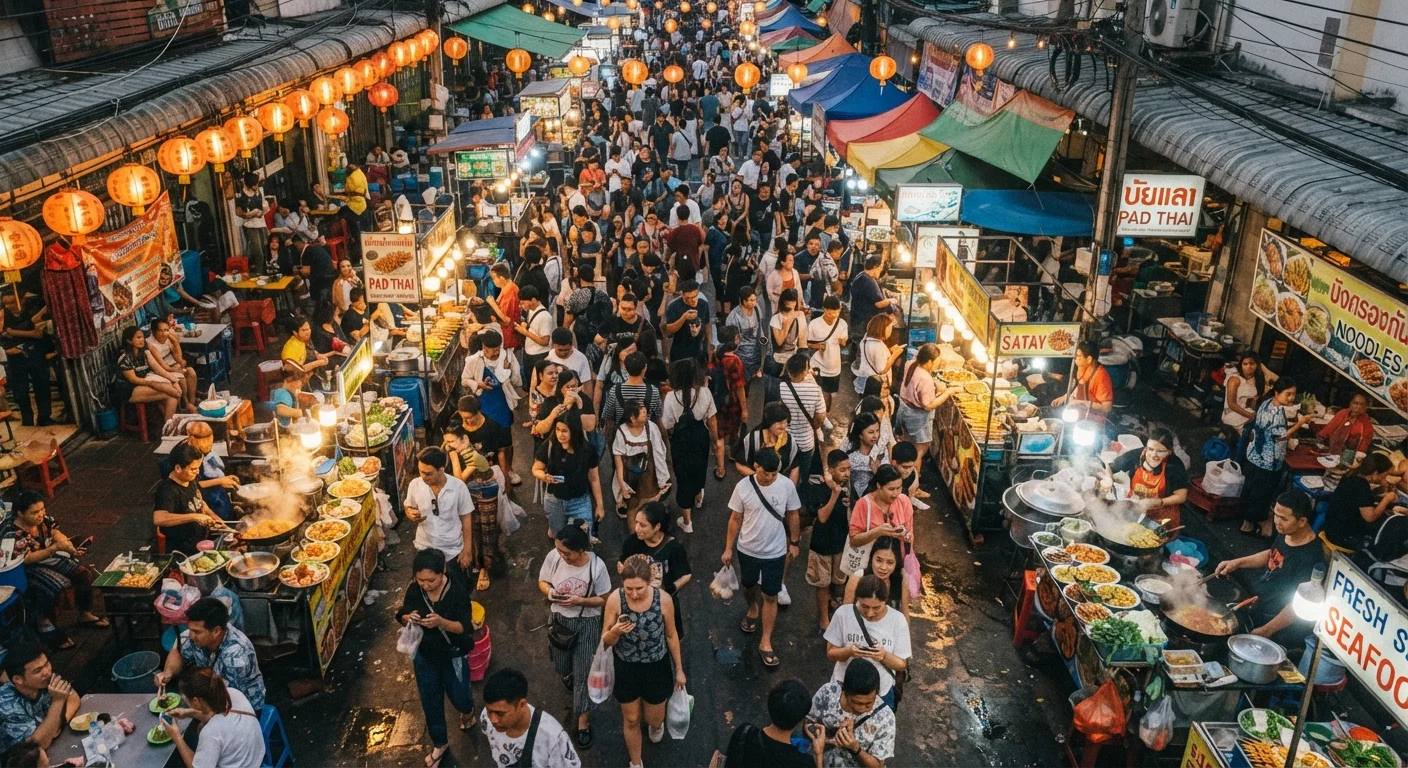
What the Street Reveals That the Restaurant Hides
A restaurant is, among other things, a performance — an edited version of a cuisine designed to satisfy a paying audience that may include tourists, business travelers, and locals seeking a special occasion. Street food, by contrast, is infrastructure. It exists because working people need to eat quickly, affordably, and close to where they spend their day.
That functional reality is precisely what makes it revealing. A city's street food scene is shaped by who needs to eat cheaply, what ingredients are locally abundant, which communities historically controlled informal commerce, and what hours the working day follows. In Bangkok, the density of noodle carts near office corridors reflects a white-collar workforce that doesn't return home for lunch. In Marrakech, the timing of harira soup vendors tracks with Ramadan fasting schedules that have structured daily life for centuries.
For travelers curious about a destination beyond its highlights, street food is one of the most efficient cultural lenses available. As a framework for cultural curiosity suggests, the goal isn't to consume experiences but to observe and interpret them thoughtfully.
2.5 billion
People who eat street food daily worldwide
The United Nations Food and Agriculture Organization estimates that approximately 2.5 billion people consume street food every day globally.
$180B+
Estimated global street food market value
Industry analysts have estimated the global street food market exceeds $180 billion annually, reflecting its role as a core part of everyday food economies worldwide.
40–70%
Share of urban food spending on street food in many developing cities
Research from the FAO suggests that in many rapidly urbanizing cities across Asia and Africa, street food accounts for a substantial share of total household food expenditure.
Ingredients as Historical Evidence
Every ingredient in a street snack has a provenance. Chili peppers appear across South and Southeast Asian street food not because they are indigenous — they arrived with Portuguese traders in the 16th century — but because they integrated so thoroughly into local cuisines that they now feel definitive. The same logic applies to the potato in Andean street markets, the peanut in West African stalls, and the flatbread traditions that trace the ancient Silk Road across Central Asia.
Trade routes, colonization, and migration leave edible evidence. Tacos al pastor in Mexico City fold together pre-Columbian corn tortillas, European pork, and a vertical spit technique brought by Lebanese immigrants in the early 20th century. A single taco, read carefully, maps a century of demographic history.
This is why street food rewards deliberate, curious observation rather than passive consumption. Asking what something is made of — and where those elements come from — opens historical conversations that menus rarely invite.
Who Sells, Who Buys, and What That Tells You
The social composition of a street food scene carries its own information. In many cities, particular ethnic or migrant communities have historically dominated street vending — both because informal markets were accessible when formal ones were not, and because food traditions traveled with diaspora communities. Understanding that dynamic helps travelers see vendors not as local color but as participants in specific economic and social histories.
Gender patterns are also instructive. In some contexts, street vending is predominantly women's work, tied to domestic food economies and supplemental household income. In others, it is dominated by men or organized along guild-like traditions. Neither pattern is universal, and both are worth noticing without projecting assumptions about what they mean.
Who buys is equally telling. A stall attracting construction workers, office clerks, and schoolchildren simultaneously is likely priced for local incomes and trusted for consistency. A stall drawing mostly tourists may have adjusted its flavors — or its prices — accordingly. That distinction matters when you're trying to read the place rather than an edited version of it. This interplay of commerce, identity, and public space connects to broader tensions travelers encounter at destinations, explored in our piece on sacred sites and tourist crowds.
“Street food is the most democratic form of cuisine. It belongs to the people who make it and the people who eat it — and it changes exactly as they change.”
— Sidney Mintz, Cultural anthropologist and food historian, author of Sweetness and Power
How to Read a Street Food Scene as a Traveler
Approaching street food as a cultural text doesn't require academic training — it requires patience and a willingness to observe before acting. A few practical habits help:
- Arrive before you buy. Watch how locals order, what they ask for, how they eat. Many customs — whether food is eaten standing or sitting, whether sauces are added by the vendor or the customer — are conveyed through behavior rather than signage.
- Note the time and place. Morning vendors often serve different purposes than evening ones. A market near a school serves different needs than one near a port. Location and timing are data.
- Ask simple questions when welcome. Many vendors appreciate genuine curiosity about their food. A basic question about an ingredient — asked respectfully, not demandingly — can yield more cultural insight than a guidebook entry.
- Be honest about your palate. Trying unfamiliar food openly, without performative disgust or exaggerated enthusiasm, is a form of respect.
Street food, read this way, becomes part of a broader practice of engaged, curious travel — the kind that leaves you with a richer understanding of a place than any single landmark can provide. It also complements other forms of cultural encounter, from festival traditions to everyday neighborhood life.
Start With Observation, Not a List
Resist the urge to arrive at a street food market with a checklist of 'must-try' items sourced from travel guides. Instead, spend the first fifteen minutes just watching — what's busy, what's being ordered, how people interact with vendors. The most meaningful meals often come from following curiosity rather than recommendations.