
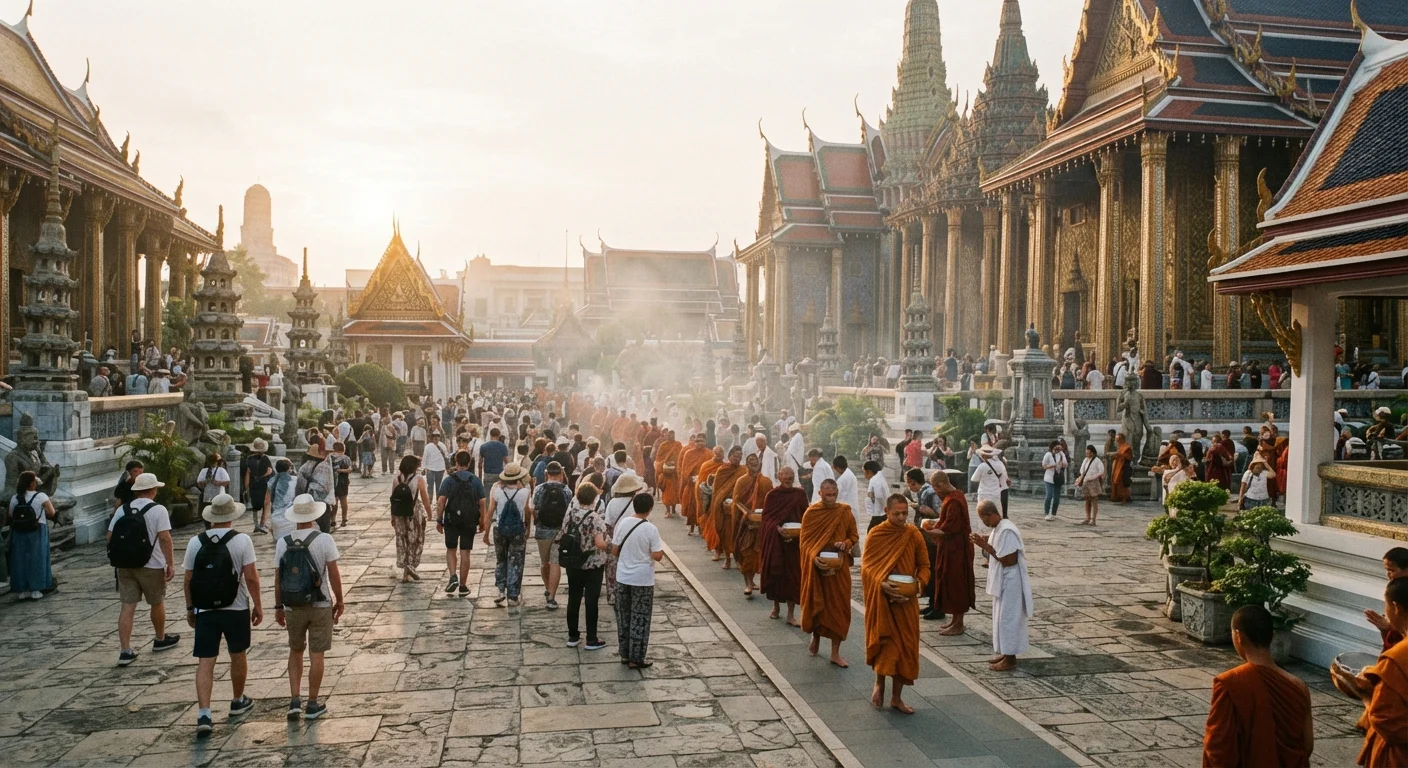
When Tourism and Worship Occupy the Same Space
Angkor Wat in Cambodia, the Western Wall in Jerusalem, St. Peter's Basilica in Vatican City, the Meenakshi Amman Temple in India — these places appear on bucket lists worldwide. They are also active sites of daily prayer, ritual, and spiritual community. That overlap is not incidental. It defines a persistent challenge that destination managers, religious authorities, and travellers all have a role in navigating.
The tension is rarely dramatic. It shows up in quieter ways: a tour group talking loudly during a service, a visitor climbing a restricted altar for a photograph, crowds blocking access routes that monks or priests use for scheduled ceremonies. Each incident is small in isolation. Collectively, they reshape how a site can function as a place of worship.
Understanding why this tension exists — and what it asks of you as a visitor — is part of travelling with genuine cultural awareness. For a broader framework on engaging with unfamiliar destinations, see approaching a destination with cultural curiosity.
Top 10
Most visited sites globally are religious in origin
Analysis by heritage researchers consistently finds that the majority of the world's highest-traffic tourism sites have religious or ceremonial origins, including the Vatican, Angkor Wat, and the Golden Temple.
800M+
Annual visitors to religious heritage sites worldwide
UNWTO (United Nations World Tourism Organization) research has estimated that religious tourism accounts for a substantial share of global travel, with hundreds of millions of trips annually tied to sites of faith.
~30%
UNESCO World Heritage Sites with active religious function
Estimates from heritage management literature suggest roughly a third of UNESCO-listed cultural sites retain active religious or ceremonial use alongside their heritage status.
Why These Sites Attract Tourists in the First Place
Sacred architecture is often the most technically ambitious and visually striking work a civilization produces. Temples, cathedrals, mosques, and shrines were deliberately built to inspire awe — which makes them naturally compelling to visitors from outside the faith tradition as well. Their age and craftsmanship give them historical significance independent of their spiritual meaning.
Tourism boards and heritage agencies also actively promote these sites because they draw visitors reliably and generate revenue. That economic incentive can make it difficult for religious communities to limit access even when they want to. The result is a dynamic where the spiritual custodians of a place must negotiate continually with tourism infrastructure that has grown up around them.
“Tourism and pilgrimage share the same roads, but they do not always share the same purpose. The challenge for heritage management is to keep both paths open without letting one erase the other.”
— David Harrison, Professor Emeritus of Tourism, SOAS University of London, writing on heritage and religious tourism
What Responsible Visitor Behaviour Actually Looks Like
Responsible conduct at sacred sites starts before arrival. Most well-managed sites publish visitor guidelines — covering dress codes, restricted zones, photography rules, and appropriate times to visit. Reading these in advance is not optional; it is baseline preparation.
On-site, the practical steps are straightforward:
- Dress as required. Many sites require covered shoulders, covered knees, or removal of shoes. These are not suggestions.
- Follow photography signs. If a space or ceremony is marked as off-limits to cameras, that rule applies regardless of what other visitors are doing.
- Observe active worship. If services or ceremonies are underway, move quietly to the perimeter or wait. You are in someone else's house of prayer.
- Keep voices low. Noise levels that feel normal in everyday settings can be disruptive in contemplative spaces.
- Stay within designated visitor areas. Barriers and roped zones usually mark areas with ritual significance, fragile materials, or restricted access for good reason.
Research Before You Arrive
Check the official website of any sacred site you plan to visit before your trip. Look specifically for dress code requirements, photography policies, restricted areas, and times when visitor access is limited due to religious services. Building this research into your planning — rather than reading signs at the door — signals genuine respect and ensures you can comply from the moment you enter.
How Destinations Manage the Balance
Site managers use a range of strategies to protect sacred character while accommodating visitor interest. Timed entry systems limit crowd density at any one moment. Designated visitor routes keep tourists away from active worship areas. Dress code enforcement at entrances sets a behavioural tone before visitors enter. Some sites close entirely to tourists during major religious festivals or daily prayer times.
Revenue from tourism can fund conservation work that religious communities could not otherwise afford — but the same crowds that generate that revenue can accelerate wear on ancient materials and disrupt the community life that gives a site its meaning. This is a genuine dilemma, not one with a clean resolution.
When choosing which destinations to visit, it is worth considering whether your visit contributes to that balance in a net-positive way — which often means travelling in smaller groups, visiting during off-peak times, and spending locally rather than only on entrance fees.
Local Custodians Set the Rules
At many sacred sites, the religious community — not the national government or tourism authority — holds primary authority over conduct and access. Their guidelines may differ from or go further than official heritage agency rules. Where both sets of guidance exist, following the more conservative standard is generally the appropriate approach.
Carrying the Awareness Forward
The fact that a place is popular does not make it public in the way a park or plaza is. Sacred sites are shared spaces whose primary purpose is spiritual, extended to visitors as a matter of openness — not handed over to tourism. Keeping that distinction in mind shapes everything from how loudly you speak to whether you step over a rope for a better photograph.
Cultural curiosity is a genuine and valuable motivation for travel. But as the research on dual-use heritage sites consistently reflects, curiosity without care can erode the very qualities that made a site worth visiting. The goal is to leave a place as intact — spiritually and physically — as you found it.
For practical guidance on building a trip that accounts for this kind of nuance, understanding how to structure a travel itinerary can help you build in the research time these destinations deserve.