
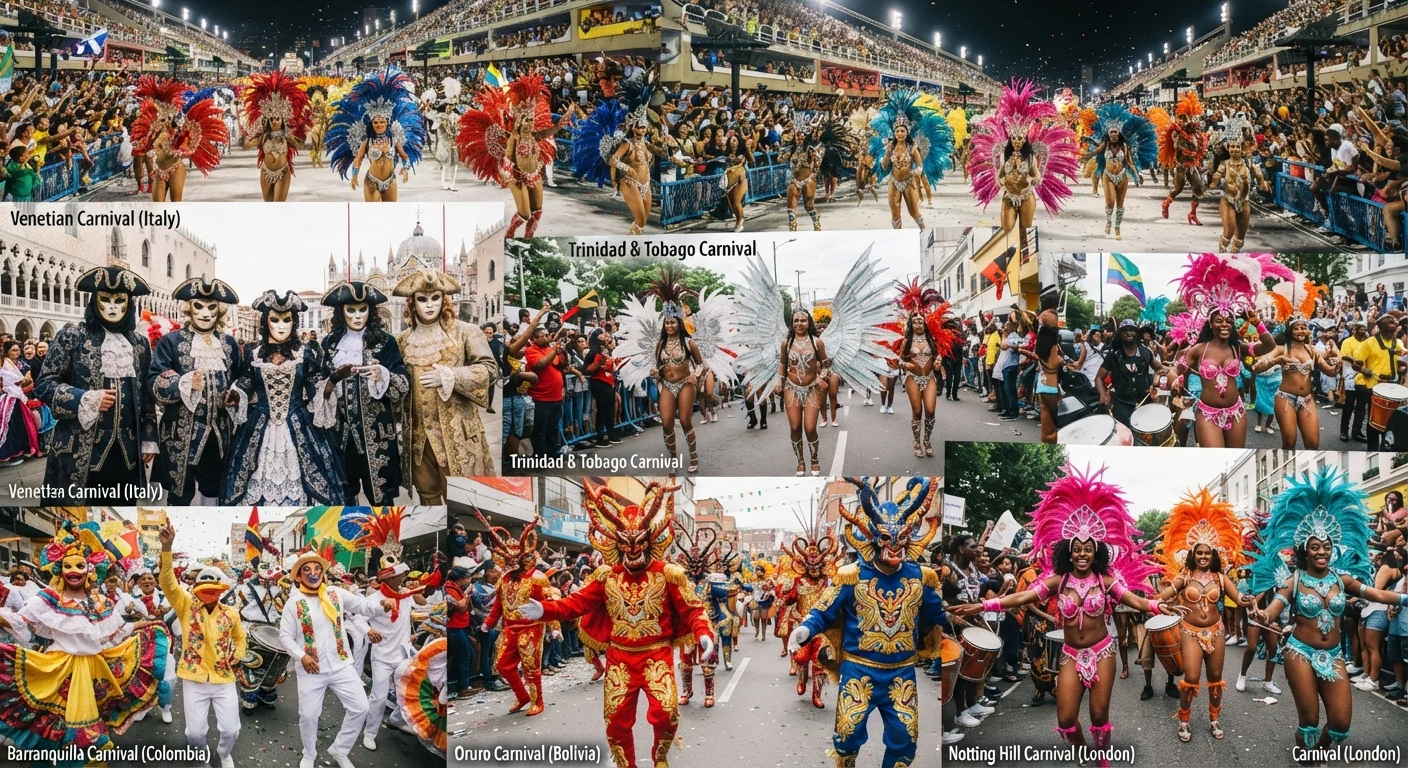
A Shared Occasion, Radically Different Expressions
The word carnival likely derives from the Latin carne vale — roughly, "farewell to meat" — referring to the feast days before the Catholic fasting period of Lent. That origin is the thread connecting celebrations from Brazil to Belgium. But colonial history, indigenous culture, African diaspora influence, and local geography have pulled each tradition in its own direction.
Understanding why carnivals look so different is really an exercise in reading history through spectacle — much like reading a destination through its street food, carnival reveals social structures, past conflicts, and living community values all at once.
| Rio de Janeiro | Venice | Trinidad & Tobago | New Orleans | |
|---|---|---|---|---|
| Primary timing | February (pre-Lent) | January–February (pre-Lent) | Sunday–Monday before Ash Wednesday | January through Fat Tuesday |
| Central tradition | Samba school parade competition | Masked costume pageantry | Mas bands, calypso, soca | Krewe parades and throws |
| Dominant music | Samba | Classical, ambient | Soca, calypso, steelpan | Jazz, brass bands, R&B |
| Historical roots | Afro-Brazilian community tradition | Venetian Republic social custom | Post-emancipation African diaspora | French colonial with African/Indigenous layers |
| Scale and crowd type | Massive; global tourists and locals | Moderate; costume-focused visitors | Large; Caribbean diaspora emphasis | Very large; mix of locals and US visitors |
| Key visual symbol | Feathered samba costume | Bauta mask | Elaborate mas costume | Beads and doubloons |
Rio de Janeiro: Competition as Performance
Brazil's Rio Carnival is the world's largest by attendance, drawing millions of visitors each February. Its centerpiece is the Sambódromo parade, where rival escolas de samba (samba schools) — neighborhood-based associations — compete across multiple nights with choreographed floats, drumlines, and thousands of costumed dancers. Judging panels score schools on everything from rhythm to costume theme coherence.
The tradition is deeply tied to Afro-Brazilian communities. Samba itself developed in early 20th-century Rio from African rhythmic traditions brought by enslaved people. The carnival's competitive structure gave working-class Black communities a formal stage and cultural ownership, even as the event later became commercialized and internationally branded.
Look Beyond the Main Parade
Rio's Sambódromo parade is the televised face of carnival, but many locals consider the street parties called blocos — free, neighborhood-based gatherings — the true heart of the celebration. Attending a bloco offers a more community-rooted experience of how Rio residents actually participate in carnival. Research neighborhood-level events before your trip for a fuller picture.
Venice: Anonymity and Aristocratic Origins
Venice Carnival dates to the 13th century and was a period when the rigid social hierarchies of the Venetian Republic were temporarily suspended. The iconic bauta mask — a full-face white mask with a projecting chin — allowed wearers of any class to move freely and anonymously through the city. Gambling, political satire, and social mixing that would otherwise be forbidden became briefly permissible.
The modern Venice Carnival, revived in 1979 after nearly two centuries of dormancy, skews more theatrical and costume-focused than raucous. Visitors parade in elaborate historical dress across the city's campi (squares) and bridges. The emphasis is on visual artistry rather than music or dance, making it one of the quieter — and most visually striking — carnivals in the world.
Trinidad and Tobago: Mas, Steelpan, and Emancipation
Trinidad and Tobago Carnival, held in the days before Ash Wednesday, is widely regarded as the foundational influence on Caribbean carnivals globally, including those in Barbados, Notting Hill (London), and Brooklyn. Its musical forms — calypso, soca, and steelpan — developed locally and spread worldwide.
The celebration carries layered meaning. Before emancipation in 1834, enslaved Africans were barred from French Creole plantation festivals; they held their own parallel celebrations. After emancipation, those traditions merged and eventually dominated. Playing mas (masquerade) is understood by many Trinidadians as a cultural right tied directly to freedom. Steelpan, invented in Trinidad in the 1930s from oil drums, is the only acoustic instrument invented in the 20th century.
1930s
Decade steelpan was invented in Trinidad
Steelpan, developed from discarded oil drums in Trinidad, is widely recognized as the only acoustic instrument invented in the 20th century.
1979
Year Venice Carnival was officially revived
After nearly two centuries without an official carnival, Venice restored the tradition in 1979 as a cultural and tourism initiative.
New Orleans Mardi Gras: Krewes, Beads, and a French Foundation
Mardi Gras — French for "Fat Tuesday" — arrived in Louisiana with French colonial settlers in the early 18th century. New Orleans' version is organized around krewes: private social clubs that fund and organize parades throughout the weeks leading up to Fat Tuesday. Each krewe has its own theme, float style, and traditions for throwing trinkets — beads, doubloons, and cups — to parade crowds.
The celebration also incorporates significant African American traditions, most notably the Mardi Gras Indians — Black New Orleans communities who create extraordinarily elaborate hand-sewn suits inspired by a historic relationship with Native American tribes. These groups parade separately from the main krewe parades, and their traditions involve months of year-round craft work. New Orleans Mardi Gras is, in many ways, several overlapping carnivals happening simultaneously in the same city.
What the Differences Actually Tell Us
Laid side by side, these four carnivals share a calendar origin and almost nothing else. Rio's event is a competitive performance arena shaped by Afro-Brazilian community pride. Venice's is a theatrical revival of aristocratic masquerade. Trinidad's is inseparable from the history of slavery and emancipation. New Orleans' is a layered civic ritual with French, African, and Indigenous roots coexisting in the same streets.
Travelers who approach carnival purely as a party risk missing the most interesting part: the reason specific costumes, music, and rituals exist at all. Asking why a tradition looks the way it does — who created it, who was excluded from it, and how it changed — turns a spectacle into a conversation with a place's past.
Verify current dates, entry requirements, and local regulations with official tourism and government sources before traveling to any carnival event, as schedules and conditions can change.