
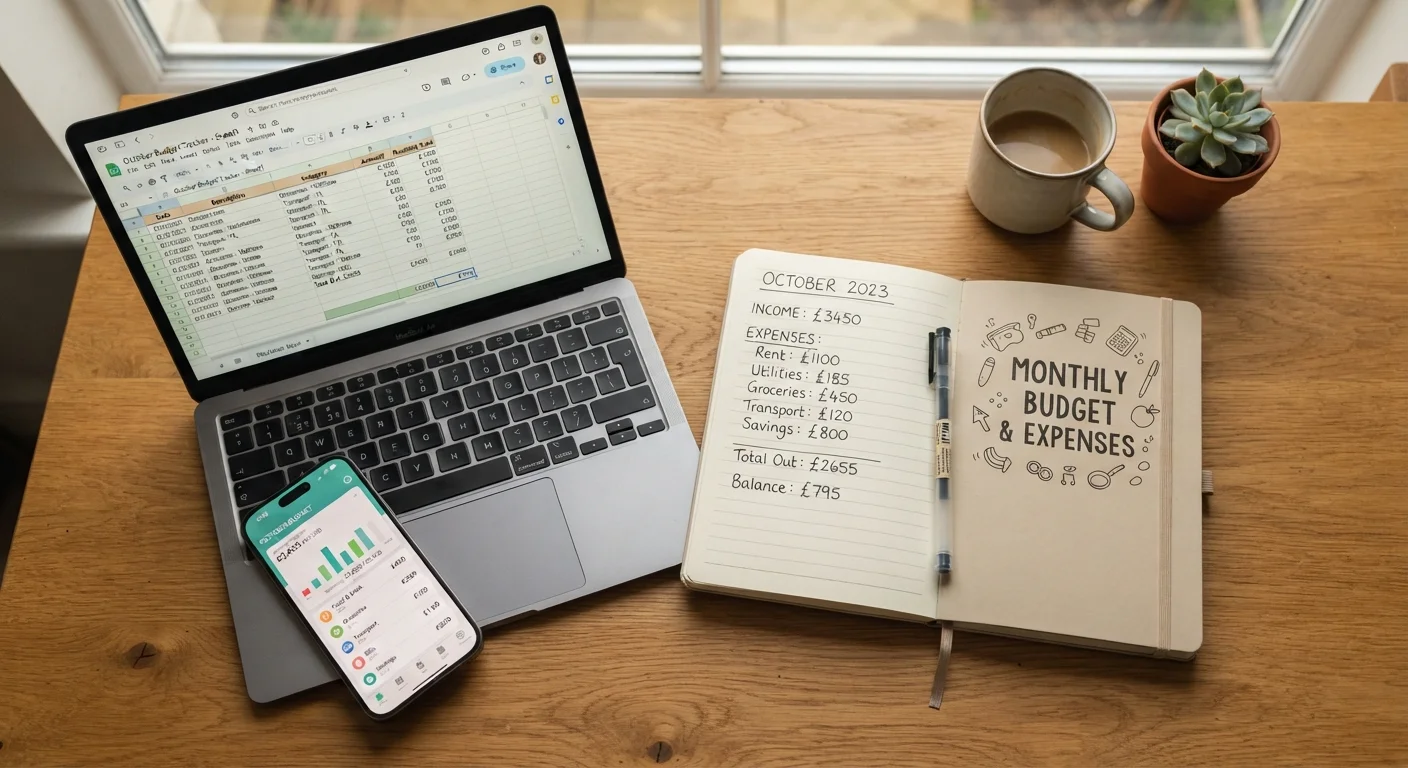
Why Tracking Spending Matters Before Anything Else
Most people who have never made a formal budget are surprised to discover where their money actually goes. Rent and groceries are obvious - but the smaller, repeated purchases are the ones that quietly reshape a financial picture month after month. Before you can set savings goals or reduce debt, you need an accurate picture of your current spending. That means tracking it.
Tracking is not about restricting yourself. It is about collecting information so you can make deliberate choices rather than reactive ones. As the daily financial decisions guide explains, small and repeated money choices are the building blocks of lasting financial patterns. Knowing which tool to use is the first practical step.
Start Simple, Then Add Complexity
If you have never tracked spending before, resist the urge to build an elaborate system on day one. Begin with just two categories - essentials (rent, groceries, utilities) and everything else - for a single month. Once you have a baseline, you can refine your categories. A simple system you actually use will always outperform a complex one you abandon.
Pen and Paper: Low Tech, High Awareness
Writing expenses down by hand is the oldest budgeting method, and it still works. The act of physically recording each transaction tends to create a stronger mental imprint than typing or automatic syncing. Research in learning science consistently shows that handwriting reinforces memory better than digital input - and that principle applies to financial habits too.
What it requires: A small notebook or ledger, a consistent daily habit of logging purchases, and a willingness to do simple addition at the end of each week or month.
Where it struggles: Forgetting receipts, losing the notebook, or skipping a few days can leave gaps that undermine accuracy. It also provides no automatic calculations or visual summaries. If your goal is to see percentage breakdowns by category, you will need to do that arithmetic yourself.
Best suited for: People who find screens distracting, prefer tactile routines, or are just starting out and want zero setup friction.
Spreadsheets: Flexible but Effortful
A spreadsheet - whether in a free tool like Google Sheets or a desktop program - sits between the simplicity of paper and the automation of apps. You build the structure once, then populate it manually each week or month. Formulas can total categories automatically, and you can design the layout to reflect how you actually think about your money.
What it requires: Some comfort with basic spreadsheet functions (SUM, simple formulas), an initial setup session of an hour or two, and regular data entry discipline.
Where it struggles: The flexibility is also a trap. A blank spreadsheet can feel overwhelming to build from scratch, and if data entry lapses for two weeks, catching up becomes a chore. Spreadsheets also require you to categorise every transaction manually, which takes time.
Best suited for: Detail-oriented planners, people splitting household costs - see approaches to splitting household bills fairly - and anyone who wants full control over how their data is structured and stored.
| Pen & Paper | Spreadsheet | App | |
|---|---|---|---|
| Setup effort | Minimal - buy a notebook | Moderate - build template | Low - account linking required |
| Data entry | Fully manual | Fully manual | Mostly automated |
| Customisation | Unlimited but unstructured | Highly customisable | Limited to app categories |
| Privacy | Fully private | Fully private | Data shared with third party |
| Visual summaries | None (DIY) | Possible with formulas/charts | Built-in dashboards |
| Cost | Negligible | Free tools available | Free to paid tiers |
| Best for cash users | Yes | Yes | Less effective |
Apps: Automated but With Trade-Offs
Spending-tracker apps can connect directly to your bank and card accounts, automatically pulling in transactions and sorting them into categories. This removes most of the manual data-entry burden and often provides charts and summaries that make patterns visible at a glance.
What it requires: Sharing your financial account credentials or granting read-access through a secure connection, choosing an app whose permissions and privacy policy you are comfortable with, and reviewing auto-categorised transactions periodically (misclassifications are common).
Where it struggles: Privacy is a genuine consideration - you are granting a third-party service access to your financial data. Apps also create a sense that budgeting is happening automatically, which can reduce the mindful engagement that makes tracking actually change behaviour. Cash purchases often require manual entry anyway, which partly negates the automation benefit. For a broader look at what automation does and does not solve, see what automating your finances actually involves.
Best suited for: People with busy schedules, those comfortable with digital tools, and anyone who responds well to visual data and progress dashboards.
Review App Permissions Carefully
Before linking any financial account to a third-party app, read its privacy policy and understand how your data is stored, shared, and protected. Look for apps that use read-only access and do not sell your transaction data. If an app's data practices are unclear, that is a reason to pause before connecting your accounts.
Choosing the Right Method for You
The most sophisticated tracking system is useless if you abandon it after two weeks. Consistency beats complexity every time. A few practical questions can help narrow your choice:
- How do you primarily pay? If you use cash often, apps lose much of their automation advantage. How you pay affects your record-keeping in ways worth understanding before picking a tool.
- How much setup effort can you invest upfront? Paper requires almost none; spreadsheets require moderate effort; apps require account linking and review.
- How important is privacy to you? Paper and spreadsheets keep your data entirely under your control.
- Do you want to understand your spending or just see it? Manual methods tend to build deeper awareness; automated ones surface patterns faster.
There is no rule against combining methods - many people log daily spending on paper for mindfulness, then transfer totals to a spreadsheet at month's end for analysis. Once you have a handle on your spending patterns, that foundation makes the next step - building savings - far easier. The Saving & Credit hub is a practical next destination.
This article is for general informational and educational purposes only and does not constitute personalised financial advice. Consider consulting a qualified financial professional for guidance specific to your situation.