
The Misconception: History as a List of Dates
Ask most students what history class is about, and they'll say something like: memorising who did what and when. That impression isn't entirely wrong - dates and names do appear on tests. But treating them as the core purpose misses almost everything valuable about the subject.
History education is more accurately described as a structured way of thinking about the past. It asks: What happened? Why did it happen when it did? Who was affected and how? What changed as a result? Those questions don't have single right answers, and that's exactly the point. Wrestling with them builds a form of reasoning that carries into science, economics, literature, and everyday decision-making.
Just as English class teaches far more than punctuation rules, history class is about much more than its surface content.
History vs. Social Studies: A Quick Distinction
History is one strand within the broader umbrella of social studies, which also covers civics, geography, and economics. In many U.S. schools, history is taught as a standalone course by middle school, but in earlier grades it often appears as part of an integrated social studies curriculum. Understanding this distinction helps students and parents interpret course descriptions and standards more accurately.
Critical Thinking Through Evidence
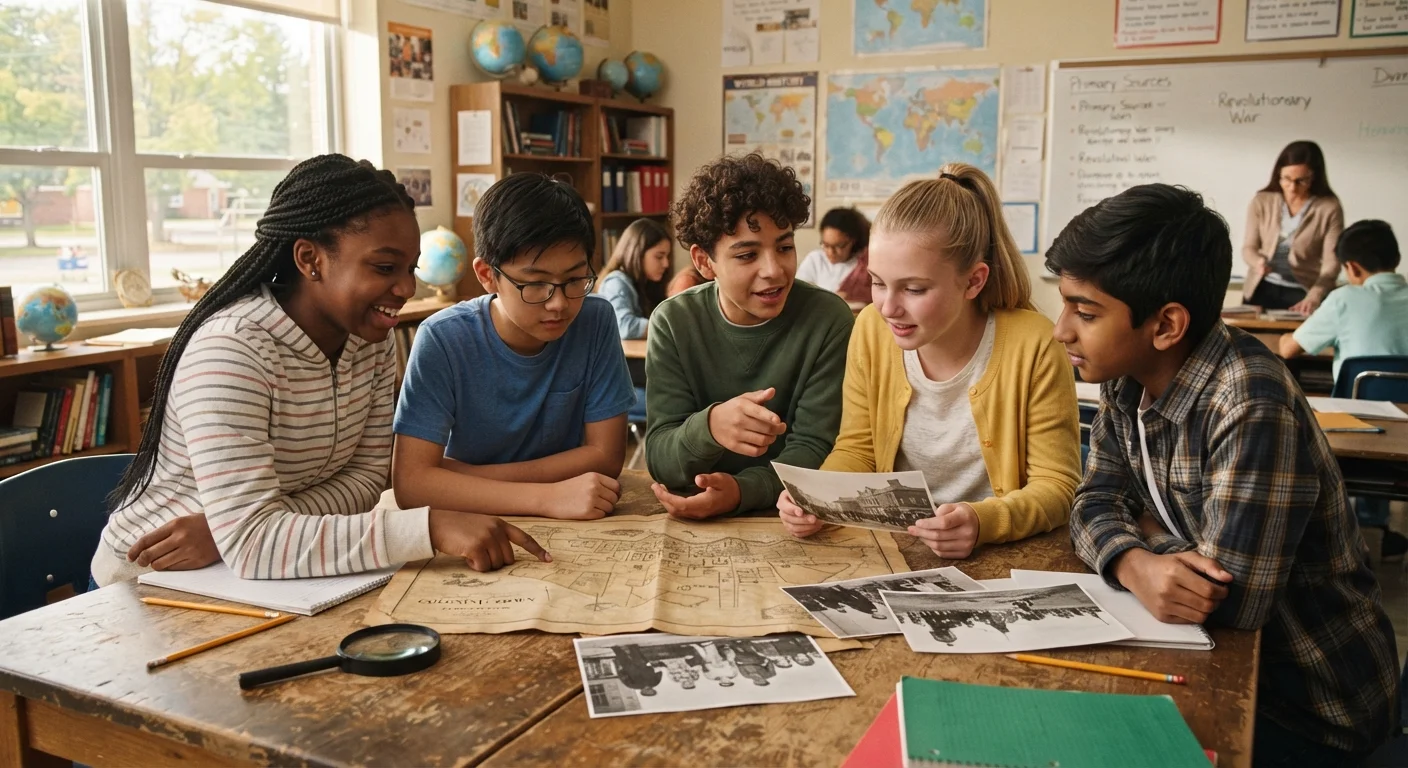
One of history's most underappreciated contributions to education is teaching students to evaluate sources. When students examine a primary source - a letter, a census record, a political cartoon - they learn to ask: Who created this? What was their perspective or agenda? What does it tell us, and what does it leave out?
This is essentially the same skill adults need to assess a news article, a social media post, or a research report. Learning to distinguish reliable evidence from opinion or propaganda is not a natural skill; it has to be practiced. History class provides structured, low-stakes opportunities to practice it repeatedly.
4 in 5
Employers who value critical thinking above technical skills
According to the National Association of Colleges and Employers, critical thinking consistently ranks among the top attributes employers seek in new graduates - a skill history education directly develops.
26 states
U.S. states requiring a civics or history exam for high school graduation
As of recent legislative tracking, more than half of U.S. states have enacted requirements tying graduation to demonstrated civic and historical knowledge, reflecting the subject's recognized importance.
~70%
U.S. adults who cannot pass a basic civics knowledge test
Surveys by the Annenberg Public Policy Center have repeatedly found that a majority of American adults struggle with basic questions about how government works - underscoring the long-term importance of early history and civics education.
Cause and Effect: The Engine of Historical Thinking
History is fundamentally a study of consequences. Every major event - a war, a migration, an invention, a policy change - has both causes that led to it and effects that rippled outward from it. Tracing those chains requires students to hold multiple variables in mind simultaneously and reason about how they interact.
This kind of thinking is not limited to the past. It's the same cognitive structure used in science experiments (what caused this result?), economic reasoning (what are the downstream effects of this policy?), and personal planning (what will happen if I make this choice?). History class trains this pattern of thought in a richly detailed context.
“History is not a burden on the memory but an illumination of the soul. To understand where we are, we must understand how we got here.”
— Lord Acton, 19th-century British historian and writer
Civic Literacy and Perspective-Taking
Understanding how governments form, why revolutions happen, how rights have been won and lost - these are not abstract academic topics. They are the background knowledge every citizen needs to participate meaningfully in a democratic society. History class builds this civic literacy directly.
Equally important is perspective-taking. Good history education exposes students to experiences outside their own - different cultures, time periods, social positions, and worldviews. This does not mean accepting every past action uncritically; it means understanding the context in which people made decisions, which is a prerequisite for genuine moral and analytical reasoning.
History also sits within the wider social studies curriculum. For a fuller look at how these subjects connect, see what students actually learn in a social studies class.
Making the Most of History Class
Students who do well in history tend to shift from passive fact-collection to active sense-making. Instead of asking "What do I need to memorise?", they ask "Why does this matter, and how does it connect to what came before?" That reframe alone improves both retention and engagement.
Practical strategies help: annotating readings with questions rather than just highlights, creating timelines that show cause-and-effect chains rather than isolated dates, and discussing events with others to surface different interpretations. These habits apply across subjects - for a structured approach, the guide to building a study session that actually sticks offers concrete techniques that work just as well for history as for any other class.
Turn Dates Into Stories
Rather than memorising a date in isolation, attach it to a cause and a consequence: "This happened because… and it led to…" That three-part structure - cause, event, effect - is far more memorable than a bare date and trains exactly the kind of analytical thinking history class is designed to build.