
What English Class Actually Covers
Ask most students what English class is about, and they'll say grammar rules or reading old books. Both answers are partially right - but neither captures the full picture. English education in the United States is built around three distinct but tightly linked strands: grammar, literature, and writing. Each strand develops a different set of skills, and together they form one of the most practical subjects in any school curriculum.
Understanding what each pillar does - and why - makes English class far less mysterious. It also helps students (and parents) recognize that the point isn't memorizing rules or summarizing plots. It's developing the ability to think clearly, communicate effectively, and engage meaningfully with the world through language.
Grammar
The system of rules and structures that govern how words are combined to form correct, meaningful sentences in a language.
Literary analysis
The practice of examining a piece of writing to understand how its elements - characters, themes, language, structure - work together to create meaning.
Expository writing
A type of writing whose main purpose is to explain or inform, presenting facts and ideas in a clear, organized way without personal opinion.
Syntax
The arrangement of words and phrases in a sentence; the set of rules that determines how sentences are structured in a language.
Narrative writing
Writing that tells a story, whether real or fictional, using characters, settings, events, and a structured sequence of action.
Rhetorical choice
A deliberate decision a writer or speaker makes about language, structure, or style in order to persuade or communicate more effectively with an audience.
Grammar: The Rules That Make Language Work
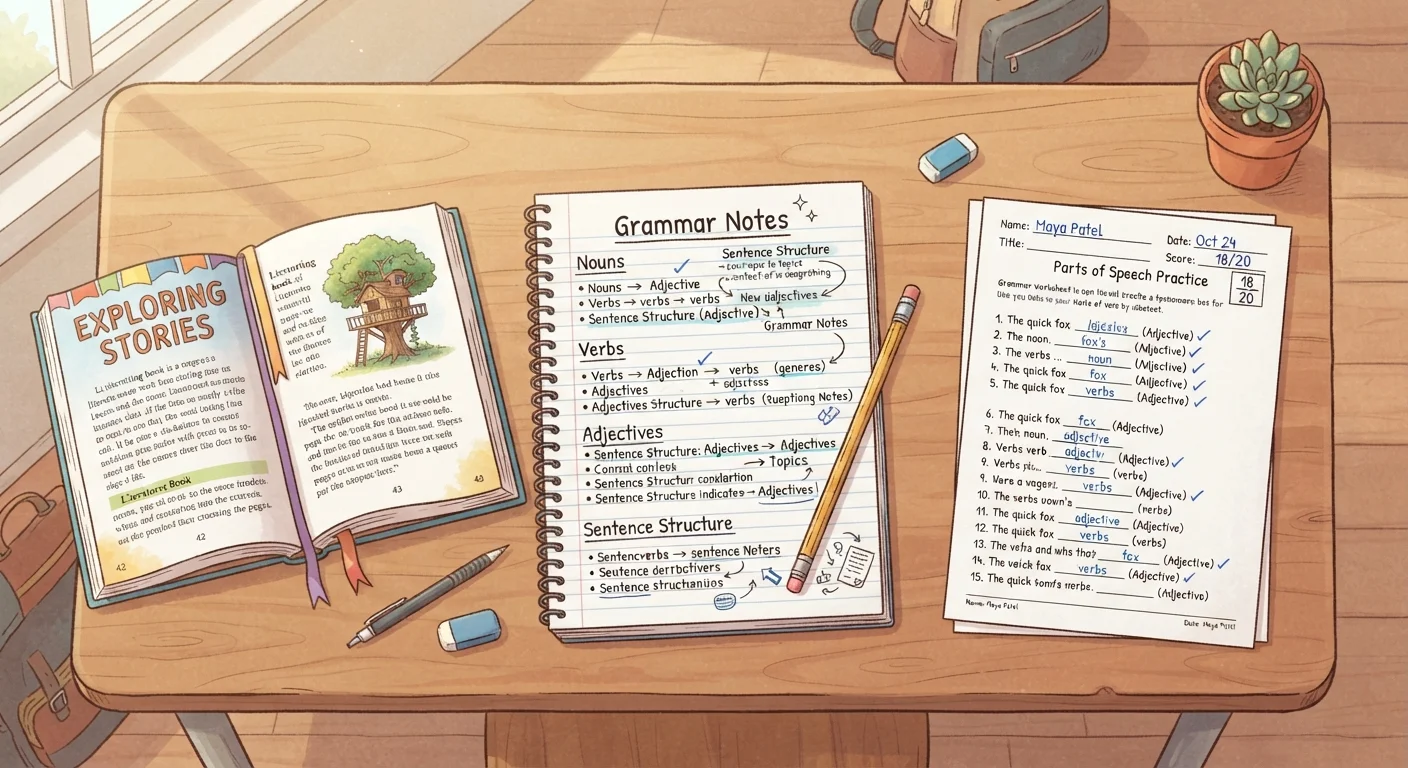
Grammar is the system underneath all language - the set of patterns and structures that allow speakers and writers to be understood. In class, grammar study typically includes parts of speech (nouns, verbs, adjectives, and so on), sentence structure, subject-verb agreement, punctuation, and the mechanics of clear, complete sentences.
But grammar instruction aims at more than rule-following. When students learn why a sentence is structured a certain way, they gain real control over how they express ideas. Knowing how a sentence works lets a writer deliberately change the pace of a paragraph, create emphasis, or avoid ambiguity. Grammar, at its best, is the study of how choices in language create meaning.
Grammar Is a Tool, Not a Test
Rather than trying to memorize every rule in isolation, focus on understanding what each grammatical structure does - how it changes meaning or clarity. When grammar is connected to real writing and reading, it becomes much easier to remember and apply. Try identifying grammatical choices in texts you already enjoy reading.
For a broader look at how studying any subject more deliberately pays off, see our complete guide to study skills.
Literature: Reading With Purpose
Literature study is often reduced to reading a book and answering questions about it. In practice, it's one of the most intellectually demanding parts of English class. Students read fiction, poetry, drama, and nonfiction - then learn to look past the surface of the text to ask: What is this really saying? How does the author create that effect? What does this reveal about human experience?
These questions build critical thinking. A student analyzing why a character makes a self-destructive choice is also learning to recognize motivation, consequence, and complexity in real life. Literature also builds empathy: inhabiting perspectives unlike your own - across time, culture, and experience - is one of the most reliable ways to develop deeper understanding of others.
Reading comprehension skills underpin all of this. As our related piece explains, comprehension exercises are designed to do far more than check whether a student finished the reading.
Writing: Finding Your Voice and Structure
Writing instruction teaches students to organize and express ideas on paper in ways that are clear, purposeful, and appropriate for the audience. Most English courses cycle through several types: narrative writing (telling a story), expository writing (explaining a topic), persuasive or argumentative writing (building a case), and literary analysis (examining a text).
Each type demands a different approach. Persuasive writing requires evidence and logical structure. Narrative writing relies on detail and pacing. Literary analysis asks students to combine close reading with clear reasoning. Learning to switch between these modes makes students flexible thinkers who can adapt their communication to any situation.
Avoid Skipping the Revision Step
Many students treat writing as a one-draft task - write it, submit it, done. But skipping revision means missing the most valuable part of the writing process: the chance to reconsider your argument, improve your sentences, and communicate more precisely. Teachers often assess growth through revision just as much as through the initial draft.
Writing instruction also develops the revision habit - the understanding that a first draft is a starting point, not a finished product. This mindset applies well beyond English class.
How All Three Pillars Connect
Grammar, literature, and writing are not three separate subjects crammed into one class period. They are genuinely interdependent. Reading literature closely makes students better writers, because they absorb how skilled authors construct sentences and build arguments. Grammar knowledge sharpens both reading comprehension and writing precision. And writing practice deepens literary understanding, because producing your own text makes you far more attentive to how other writers make their choices.
This integration is what makes English class unusual. Unlike a subject with one clear body of content, English is fundamentally about the tools of thought and communication themselves. Those tools show up in every other subject - and in adult life. Just as history class builds more than factual knowledge, English class builds more than reading and writing. It builds the capacity to learn, argue, empathize, and express - skills that compound across a lifetime.
Purdue Online Writing Lab (OWL)
A widely used, free resource covering grammar rules, writing style, and citation formats. Useful for students at all levels looking to strengthen their writing fundamentals.
Project Gutenberg
A free digital library of classic literary works that are in the public domain. A practical starting point for exploring the texts commonly studied in English classes.