
Why the Layout Is the Lesson
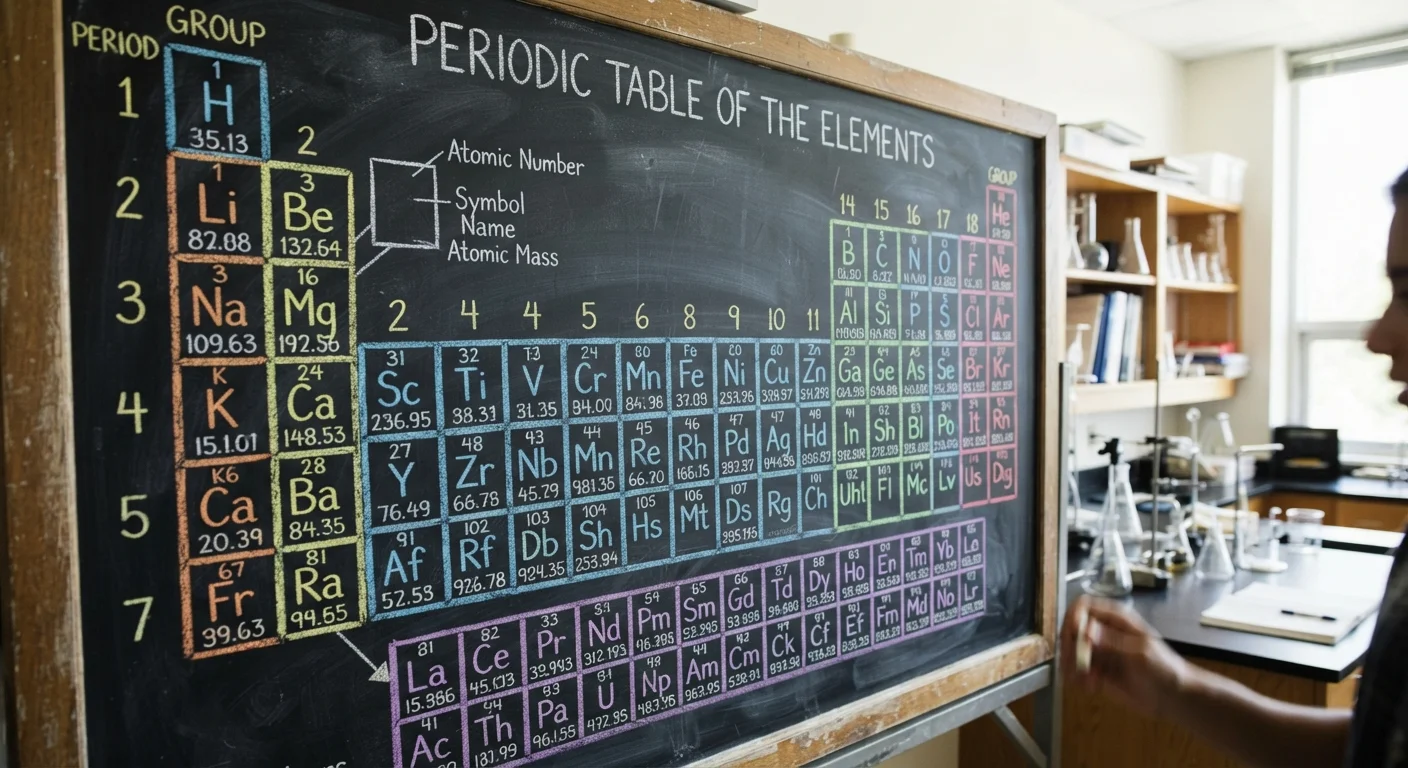
The periodic table isn't arranged randomly. When Russian chemist Dmitri Mendeleev organized elements by increasing atomic mass in 1869, he noticed repeating patterns in their behavior - and left gaps for elements not yet discovered. Today's table arranges elements by atomic number (the number of protons in an atom's nucleus), and that single organizing principle explains almost everything else on the chart.
Think of it like a map: just as geography tells you what climate to expect, an element's position on the table tells you about its physical properties, reactivity, and how it bonds with other elements. Once you know the map's legend, you can read any element at a glance.
| Total confirmed elements | 118 (IUPAC, current standard) |
| Number of periods (rows) | 7 |
| Number of groups (columns) | 18 |
| Original organizer | Dmitri Mendeleev, 1869 (Arranged by atomic mass; modern table uses atomic number) |
| Most abundant element in Earth's crust | Oxygen (O) (U.S. Geological Survey) |
| Only liquid metal at room temperature | Mercury (Hg) |
Reading the Rows: What Periods Tell You
Each horizontal row is called a period. There are seven periods in the modern table. Moving left to right across a period, the atomic number increases by one each step - meaning each element has one more proton than the last.
More importantly, all elements in the same period have the same number of electron shells (also called energy levels). Period 1 elements (hydrogen and helium) have one electron shell. Period 2 elements have two shells, and so on. This matters because electron shells determine an atom's size and influence how it interacts with other atoms. Elements generally get smaller as you move left to right across a period, because more protons pull the electrons in tighter.
Atomic Number
The number of protons in the nucleus of an atom. It uniquely identifies each element and determines its position on the periodic table.
Period
A horizontal row on the periodic table. All elements in a period have the same number of electron shells.
Group (Family)
A vertical column on the periodic table. Elements in the same group share the same number of valence electrons and exhibit similar chemical behavior.
Valence Electrons
Electrons located in the outermost shell of an atom. They determine how an element bonds and reacts with other elements.
Electronegativity
A measure of how strongly an atom attracts electrons in a chemical bond. It increases moving right and upward across the periodic table.
Metalloid
An element with properties intermediate between metals and nonmetals. Metalloids like silicon are critical in electronics and semiconductor manufacturing.
Reading the Columns: What Groups Tell You
Vertical columns are called groups (or families), and they are the table's most powerful predictive tool. The 18 groups are numbered across the top. Elements in the same group share the same number of electrons in their outermost shell - called valence electrons - and that similarity produces strikingly similar chemical behavior.
Group 1, the alkali metals (like lithium, sodium, and potassium), each have one valence electron and are highly reactive with water. Group 17, the halogens (like fluorine and chlorine), each have seven valence electrons and are eager to grab one more, making them highly reactive with metals. Group 18, the noble gases (like helium and argon), have full outer shells and rarely react with anything at all.
118
Known elements organized on the table
As recognized by the International Union of Pure and Applied Chemistry (IUPAC), including both naturally occurring and synthetically produced elements.
94
Elements found naturally on Earth
Elements with atomic numbers 1-94 occur in nature; the remaining 24 have been produced artificially in laboratory settings.
~75%
Proportion of elements that are metals
The majority of the periodic table is occupied by metallic elements, spanning alkali metals, alkaline earth metals, transition metals, and others.
Color Zones and Special Sections Explained
Most periodic tables use color coding to highlight broad categories. The main ones to know:
- Metals (left and center): good conductors of heat and electricity, typically solid at room temperature, and malleable.
- Nonmetals (upper right): poor conductors, often gases at room temperature, and essential to life chemistry - carbon, oxygen, and nitrogen all live here.
- Metalloids (the staircase border): elements like silicon and germanium that share properties of both metals and nonmetals, making them crucial in semiconductor technology.
You'll also notice two rows separated below the main table - the lanthanides and actinides. These are pulled out purely for space; they technically belong in periods 6 and 7 but would make the table impractically wide if kept inline. Many actinides are radioactive and man-made in laboratories.
Just as colors in nature carry coded meaning, the color zones on a periodic table are a shorthand system - once learned, they let you decode an element's behavior at a glance.
Trends You Can Predict Without Memorizing
The table's layout makes several chemical trends visible without any memorization. These are called periodic trends:
- Electronegativity increases moving right and up - fluorine (top-right corner) is the most electronegative element.
- Atomic radius increases moving left and down - francium (bottom-left) is among the largest atoms.
- Ionization energy (the energy needed to remove an electron) increases moving right and up - noble gases hold their electrons most tightly.
These trends exist because of the interplay between the number of protons pulling electrons inward and the number of electron shells pushing them outward. The table makes those forces visible spatially.
Understanding the periodic table is a foundational skill - much like reading a set of warning signals - once you know the system, patterns that looked like noise suddenly carry clear meaning. With rows telling you about electron shells and columns telling you about valence electrons and reactivity, the periodic table becomes less a thing to memorize and more a tool to think with.