
The Journey Air Takes Into Your Body
Every breath you take sets off a rapid chain of events involving dozens of coordinated structures. Far from being a simple in-out pump, the respiratory system filters, warms, humidifies, and chemically samples the air before it ever contacts your blood.
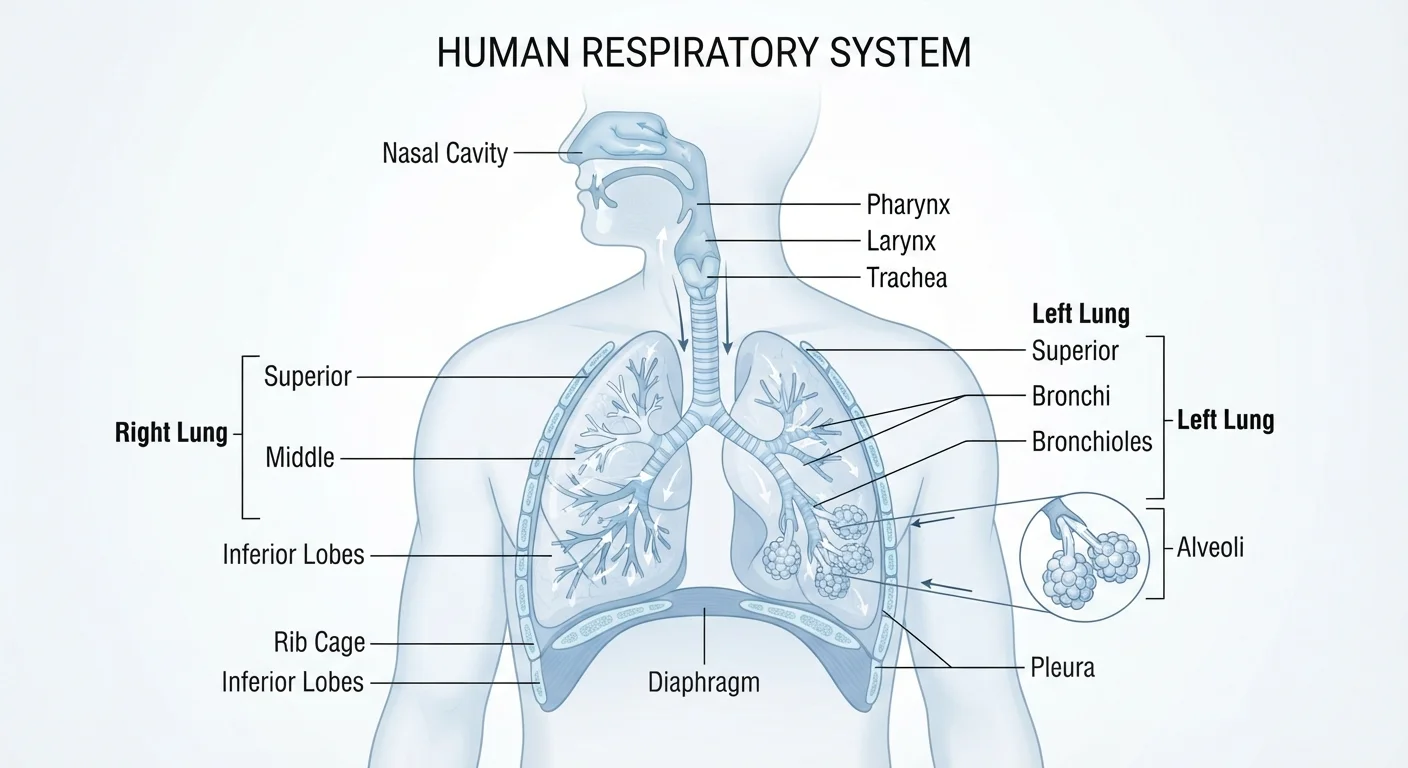
Air enters through the nose (or mouth), where coarse hairs and a mucus-coated lining trap large particles and begin warming the air toward body temperature. It then passes through the pharynx (throat) and the larynx (voice box), which houses the epiglottis - a flap that reflexively covers the airway when you swallow to prevent food and liquid from entering the lungs.
From there, air travels down the trachea (windpipe) and splits at a fork called the carina into the left and right bronchi. These branch progressively smaller - into bronchioles - forming a tree-like structure sometimes called the bronchial tree. The smallest branches terminate at clusters of tiny air sacs: the alveoli.
Alveoli
Microscopic air sacs at the ends of the bronchioles where oxygen enters the blood and carbon dioxide is released to be exhaled.
Diaphragm
A large dome-shaped muscle beneath the lungs that contracts and relaxes to drive the mechanical process of breathing.
Gas exchange
The process by which oxygen moves from the lungs into the bloodstream and carbon dioxide moves from the blood into the lungs to be breathed out.
Cilia
Tiny hair-like projections lining the airways that sweep mucus and trapped particles upward and out of the lungs.
Chemoreceptors
Specialized sensory cells that detect chemical changes in the blood - especially carbon dioxide levels - and signal the brain to adjust breathing rate.
Bronchioles
The smallest branches of the airway passages inside the lungs, leading air from the larger bronchi to the alveoli.
The entire airway is lined with mucus-secreting cells and hair-like cilia that continuously sweep debris upward and out - a self-cleaning mechanism that runs non-stop, even while you sleep.
How Gas Exchange Actually Works
The alveoli are where the respiratory system's core mission is accomplished. Each lung contains an estimated 300 to 500 million alveoli, providing a combined surface area roughly the size of a tennis court - all folded into two fist-sized organs.
The alveolar walls are just one cell thick and wrapped in a dense network of capillaries (tiny blood vessels). This paper-thin barrier allows oxygen to diffuse from the air inside the alveolus into the bloodstream, while carbon dioxide - a waste product of cellular metabolism - diffuses the other direction, from the blood into the alveolus, to be exhaled.
This swap is driven by partial pressure gradients: gases naturally move from areas of higher concentration to lower concentration. Oxygen is abundant in fresh inhaled air; the returning blood from the body has used much of its oxygen and carries excess CO₂. The gradient does the work - no active pumping required at the alveolar membrane itself.
Your Lungs Don't Breathe - Your Diaphragm Does
Lung tissue itself has no muscle; it can't actively expand or contract on its own. The diaphragm and intercostal muscles create pressure changes that pull air in and push it out. Learning diaphragmatic (belly) breathing is a common technique taught in breath-focused practices to promote fuller, more efficient inhalation.
The diaphragm - a dome-shaped muscle beneath the lungs - is the primary driver of this whole process. When it contracts and flattens, lung volume increases and air rushes in (inhalation). When it relaxes and rises, air is pushed out (exhalation). Smaller intercostal muscles between the ribs assist, especially during exercise.
What Controls Your Breathing Rate
You can choose to hold your breath or breathe faster for a short time, but moment-to-moment control of breathing is largely automatic. The respiratory control centers in the brainstem - primarily the medulla oblongata and the pons - continuously monitor blood chemistry and send signals to the breathing muscles.
The key signal is not oxygen, as many people assume. The brainstem is primarily sensitive to rising carbon dioxide levels (and the resulting drop in blood pH). When CO₂ climbs - during exercise, for instance - the control center increases both rate and depth of breathing to clear it faster. Specialized chemoreceptors in the brainstem and in the carotid arteries relay this data in real time.
CO₂ Is Not Just a Waste Gas
While carbon dioxide is indeed a metabolic byproduct, it also serves as the body's primary chemical signal for regulating breathing and blood pH. The brainstem is exquisitely sensitive to CO₂ fluctuations - which is why techniques like slow, controlled breathing can measurably affect heart rate and perceived stress levels.
Emotional states, pain, and fever can also temporarily shift breathing patterns - a reminder that the respiratory system is woven into the body's broader stress and homeostatic responses, not just a mechanical pump.
How Breathing Connects to the Rest of Your Body
The respiratory system does not work in isolation. Its most immediate partner is the cardiovascular system: the heart pumps oxygen-depleted blood to the lungs and returns oxygenated blood to the body. Without adequate gas exchange, no amount of cardiovascular effort can keep tissues supplied. You can explore this relationship further in our article on how the cardiovascular system works.
Breathing also plays a role in acid-base balance. Because CO₂ dissolved in blood forms carbonic acid, the lungs provide one of the body's fastest mechanisms for adjusting blood pH - responding in seconds compared to hours for the kidneys to act.
Even the air quality in your immediate environment feeds into this system. Airborne irritants and pollutants can trigger inflammation in the airways, impair mucociliary clearance, and over time affect how efficiently gas exchange occurs. Our guide on home ventilation and air quality covers practical ways to support cleaner indoor air.
Breathing is also one of the few autonomic functions you can consciously influence - a fact explored further in our piece on remarkable things your body does without you noticing.
This article is for general informational and educational purposes only and is not a substitute for professional medical advice, diagnosis, or treatment. Always consult a qualified healthcare professional with any questions you have about a medical condition or symptom.