
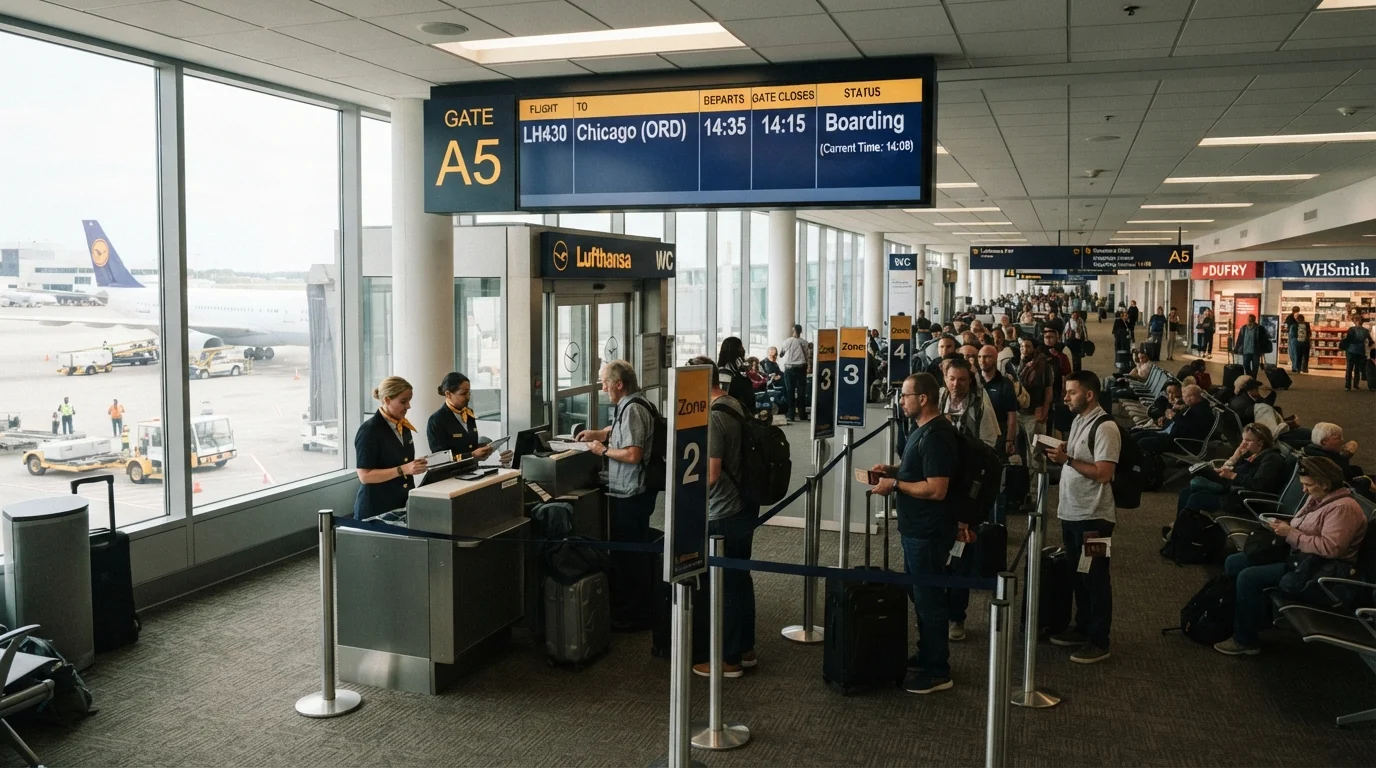
What 'Gate Closes' Actually Means
The phrase gate closes appears on boarding passes and airport screens, yet many travelers misread it as simply another way of saying the flight is departing. These two times are not the same thing.
Gate close time is the point at which airline staff seal the boarding door and stop accepting passengers. This typically occurs 10 to 15 minutes before the scheduled departure time, though exact cutoffs vary by airline and destination. International flights sometimes close gates 20 or more minutes early due to customs and documentation checks.
After the gate closes, the aircraft may still be physically connected to the jetway — but you will not be allowed on. The airline has finalized the passenger count, submitted documentation to the crew, and begun pre-departure procedures. Knocking on the jetway door after this point is not an option that gate agents can accommodate.
Security Comes Before the Gate
Before you even reach the gate, getting through security efficiently sets the tone for your airport experience. See our plain-language walkthrough of airport security screening to understand what to expect at the checkpoint. Clearing security with time to spare is the single most reliable way to avoid gate-close stress.
Before you even reach the gate, getting through security efficiently sets the tone for your airport experience. See our plain-language walkthrough of airport security screening to understand what to expect in the security lane.
How Boarding Sequences Are Structured
Most U.S. airlines organize boarding into groups or zones — numbered or lettered tiers that determine when each passenger walks down the jetway. Your boarding pass will show your assigned group, typically printed near the seat number.
The general sequence across most major carriers follows this pattern:
- Pre-boarding: Passengers with disabilities, unaccompanied minors, and families with children under two years old.
- Premium cabins: First class and business class ticket holders.
- Elite frequent flyers: Travelers with top-tier status in the airline's loyalty program.
- Co-branded credit card holders: Passengers who hold the airline's affiliated credit card often receive an earlier group.
- General boarding groups: Remaining passengers, called in numbered waves (Group 1 through 5 or more, depending on the carrier).
The system is designed to fill the aircraft from back to front in most cases, minimizing the bottleneck of passengers stopping mid-aisle to load bags. Some airlines use outside-in seating sequences (window seats first, then middle, then aisle) which research suggests can speed up boarding further.
10–15 min
Typical gate close window before departure
Most U.S. domestic carriers close the boarding door 10 to 15 minutes ahead of scheduled departure time.
5–8
Average number of boarding groups per flight
Larger U.S. carriers commonly use five to eight distinct boarding groups or zones on full-size aircraft.
20+ min
Gate close lead time on many international flights
International departures often require earlier gate closure due to documentation, customs, and security procedures.
Why Boarding Order Matters to You
Your group number has two practical consequences beyond simply knowing when to stand up.
Overhead bin space is finite. Passengers in the final boarding groups frequently find bins near their seats already full, requiring them to stow carry-on bags several rows forward or aft. Retrieving those bags after landing adds time and congestion.
Stress reduction is also real. Travelers who board early have time to settle, stow luggage calmly, and review safety information before the cabin fills. Rushing to board last — especially on a full flight — often means navigating a packed aisle with little room to maneuver.
Consider Upgrading Your Boarding Group
If overhead bin space is a concern, check whether your airline allows you to upgrade your boarding group for a small fee at check-in or at the gate. This option is commonly available and, on many carriers, costs less than checking a bag at the counter.
If overhead bin space is a concern, check whether your airline allows you to upgrade your boarding group for a fee at check-in or at the gate. This option is commonly available and costs less than checking a bag on many carriers.
Practical Tips for a Smooth Boarding Experience
Knowing the rules helps you use them to your advantage. A few straightforward habits make a meaningful difference:
- Arrive at the gate early. Most airlines recommend being at the gate at least 30 to 45 minutes before departure. Gate agents begin closing the door before you might expect.
- Listen for your group. Boarding calls are made by group number over the PA. Standing in line before your group is called clogs the boarding lane and is discouraged by staff.
- Have your boarding pass ready. Whether digital or printed, have it accessible and screen brightness turned up before you reach the scanner.
- Know your bin strategy. If you board late and bins are full, a gate agent can check your bag to the destination at no charge — this is called a gate check.
Understanding the structure behind boarding sequences removes much of the guesswork from the gate area. When you know what each call means and when your moment to board arrives, the process becomes considerably less stressful.