
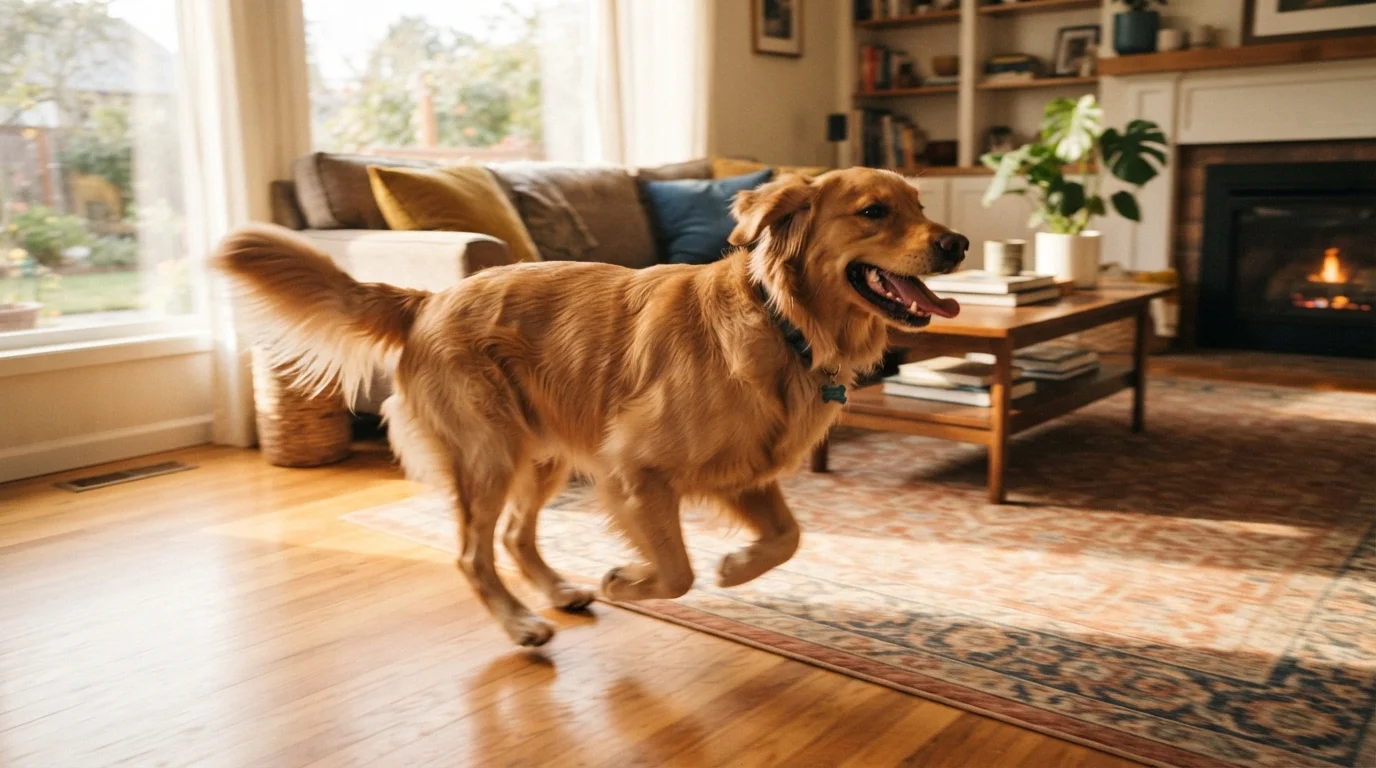
What's Actually Happening During a Zoomies Episode
When your dog suddenly launches into a frantic lap of the living room or your cat rockets off the sofa for no apparent reason, you're watching a Frenetic Random Activity Period — a FRAP, more affectionately known as the zoomies. The movement is typically explosive: tight circles, sudden direction changes, and a slightly wild look in the eyes that owners often describe as a pet being "not quite themselves."
What's happening physiologically is an acute release of accumulated energy through the motor system. Think of it as a pressure valve. When emotional or physical energy builds up beyond a certain point — whether from excitement, relief, or simple restlessness — the nervous system discharges it in one fast, dramatic burst. The pet isn't misbehaving; they're regulating.
Animal behaviorists consider FRAPs a normal part of the behavioral repertoire for many species. You'll see it in dogs, cats, rabbits, ferrets, guinea pigs, and even horses. The universality of the behavior across species suggests it serves a real biological function rather than being a quirk of domestication.
FRAPs
Scientific term for the zoomies
Frenetic Random Activity Periods is the formal behavioral science term used by veterinarians and animal behaviorists to describe the phenomenon.
30–120 sec
Typical duration of a zoomies episode
Most FRAP episodes are brief, self-limiting bursts that resolve on their own without any intervention from the owner.
Multiple species
Animals known to experience FRAPs
Zoomies have been documented in dogs, cats, ferrets, rabbits, horses, and other companion and domestic animals, suggesting a shared biological basis.
Common Triggers for the Zoomies
Zoomies don't appear randomly — even when they feel that way. Certain situations reliably set them off:
- Post-bath relief: Many pets find bathing mildly stressful. Once it's over, the emotional pressure releases in a frantic dash around the house.
- After elimination: Dogs and cats frequently get zoomies immediately after using the bathroom. One behavioral explanation is that the act of elimination temporarily increases vulnerability in the wild, so the burst of movement afterward may be an instinctive "all clear" response.
- Pent-up physical energy: A pet who has been crated, confined, or under-exercised for a period will often zoom when finally given space. Evening zoomies in dogs are a classic sign that daytime activity levels weren't quite enough.
- Social excitement: Greeting a favorite person, meeting another dog, or anticipating a walk can all spike arousal high enough to trigger a FRAP.
- Playful provocation: Sometimes one pet zooming sets off another — a contagious burst of joy between housemates.
Understanding your pet's specific triggers can help you anticipate episodes and set up a safe environment in advance. See our guide to commonly misread pet signals for more context on how emotional states show up in animal behavior.
Make Space Before the Zoomies Start
If you know a FRAP trigger is coming — a bath, a greeting, or letting your pet out after a long rest — take a moment to clear fragile items from the room and prop open doors to give them a safe running loop. A little preparation prevents accidents without interrupting a perfectly healthy behavior.
Why Puppies and Kittens Zoom More
Young animals experience the zoomies far more often than adults, and the intensity tends to be higher. There are two main reasons for this. First, puppies and kittens have not yet developed the same capacity for sustained, self-regulated activity as adult animals — their energy comes in sharp peaks rather than steady flows. Second, they are still learning how their bodies work, and vigorous spontaneous movement is part of normal motor development.
As pets mature, their zoomies become less frequent and typically shorter. Senior pets may still have the occasional FRAP, especially during a happy or stimulating moment, but the manic sprints of puppyhood usually settle considerably by adulthood.
If an adult or senior pet suddenly starts zooming much more than usual, it's worth considering whether their exercise routine has changed or whether a stressor has been introduced. Occasionally, increased restless movement in older animals warrants a veterinary conversation — though in most cases, the explanation is simply a change in daily routine.
When to Let It Happen — and When to Check In
In the vast majority of cases, the right response to a zoomie episode is to enjoy it. Clear a safe path, make sure outdoor spaces are securely enclosed, and let your pet burn through the energy naturally. Avoid chasing your pet during a FRAP — it can escalate arousal further and turn a self-limiting burst into extended overexcitement.
However, a few situations deserve attention. If your pet's spinning is always in the same direction and they seem disoriented, that is worth mentioning to a veterinarian, as it can sometimes indicate an inner ear or neurological issue. Similarly, if what looks like zoomies is actually continuous, compulsive pacing with no moment of calm, that distinction matters — repetitive behaviors that don't self-resolve can signal anxiety or an underlying health condition.
Frequent, daily zoomies in an otherwise healthy adult dog may also be a signal worth acting on — not because zoomies are harmful, but because they may indicate the pet needs more structured activity. Our overview of how boredom affects pet wellbeing explains how unmet stimulation needs show up in behavior.
“Zoomies are one of the clearest expressions of positive emotional arousal we see in companion animals. When a pet zooms, they're not being disobedient — they're communicating that they have energy to spare and feel safe enough to spend it.”
— Applied Animal Behaviorist, Certified Applied Animal Behaviorist (CAAB), generalized from published behavioral literature on feline and canine FRAPs