
Why These Words Confuse People
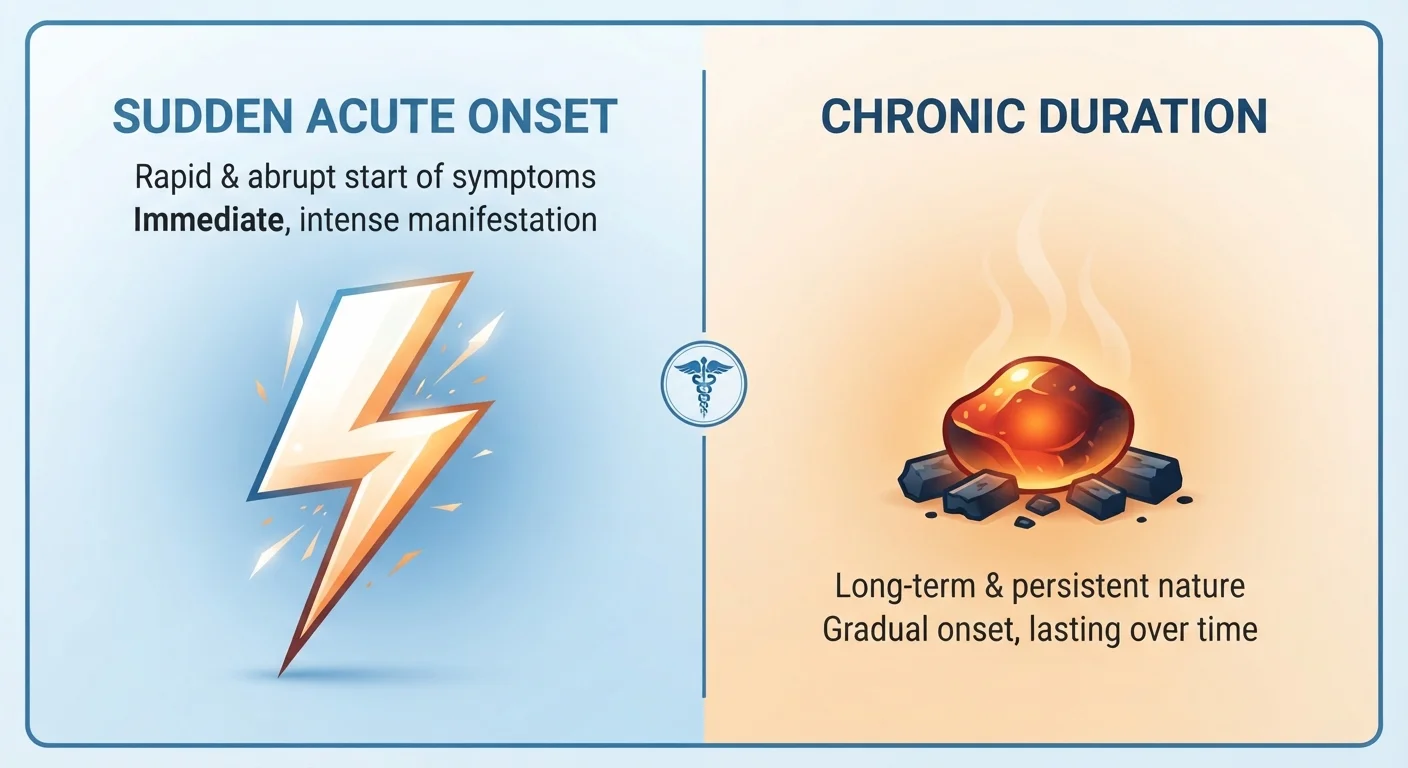
Most people assume "acute" means severe and "chronic" means mild - a logical guess, but medically incorrect. A panic attack is acute; so is a broken bone. Meanwhile, a subtle, nagging headache that has lasted four months is chronic. The confusion is understandable because in everyday English, acute often implies sharpness or intensity. In clinical contexts, however, both terms function as time descriptors, nothing more.
This distinction matters practically. When you describe a symptom to a clinician using accurate time language - when it started, whether it comes and goes, how long each episode lasts - you give them cleaner information to work with. Vague or mislabeled descriptions can slow down the diagnostic process. See our guide to common symptom-description pitfalls for more on why precise communication with a provider matters.
What 'Acute' Actually Means
The word acute comes from the Latin acutus, meaning sharp or pointed - referring to the rapid onset, not the pain level. An acute symptom appears suddenly, peaks relatively quickly, and usually resolves within a matter of days to a few weeks. The body's response to an infection, an injury, or an allergen are all classic examples of acute processes.
3+ months
Standard threshold for a chronic symptom or condition
Most clinical guidelines, including those from major health organizations, use a three-month or 12-week minimum duration to classify a symptom or condition as chronic.
~51%
U.S. adults living with at least one chronic condition
According to the CDC, approximately half of all American adults have been diagnosed with at least one chronic health condition, underscoring how common long-duration health issues are.
Acute symptoms often feel dramatic because of their abruptness, and many prompt people to seek care immediately - which is sometimes exactly right. Sudden shortness of breath, a first-ever severe headache, or chest tightness should be evaluated promptly. But plenty of acute symptoms - a sore throat from a cold, muscle soreness after exercise - are self-limiting and resolve without intervention.
The key clinical question with any acute symptom is: does this need urgent assessment, or is watchful waiting appropriate? That judgment belongs to a healthcare provider, not to a label.
What 'Chronic' Actually Means
A symptom or condition is generally described as chronic when it has persisted for three months or longer. Some medical guidelines use 12 weeks as the formal cutoff. Chronic does not imply that a condition is untreatable or worsening - it simply signals that the body has not returned to its previous baseline within a typical recovery window.
Chronic symptoms are often less dramatic in their moment-to-moment presentation than acute ones, but their cumulative effect on daily life can be significant. Persistent fatigue, long-standing joint stiffness, or recurring digestive discomfort are all examples. Interestingly, what begins as an acute symptom - say, post-infection cough - can transition into a chronic one if it continues beyond the expected resolution timeframe.
Track Symptom Duration Before Your Appointment
Before seeing a healthcare provider, jot down when a symptom first appeared, whether it has been constant or intermittent, and any factors that seem to worsen or improve it. Even rough notes can help a clinician determine whether a symptom is acute, subacute, or chronic - and that context can meaningfully shape the conversation.
It's also worth noting that chronic conditions can coexist with acute flares. Someone managing a chronic condition may experience sudden-onset episodes that are more intense than their usual baseline. Clinicians refer to this as an acute-on-chronic presentation, and it typically warrants separate evaluation. For a broader look at how different symptoms map to body systems, see our practical overview of common symptoms across body systems.
Using These Terms to Communicate Better
Understanding the distinction between acute and chronic gives you a more precise vocabulary for describing what you're experiencing - which can genuinely improve a medical consultation. Instead of saying "I've had this pain forever," you can note that it has been present for four months, is mostly consistent, and occasionally flares. That framing helps a provider categorize the problem and prioritize next steps.
Duration, pattern, and any changes over time are among the most useful details you can bring to an appointment. Whether a symptom is constant or intermittent, whether it is getting better, worse, or staying the same - these observations complement the acute/chronic framework and give a clearer picture. If you experience symptoms that feel unusual or persistent, reaching out to a qualified healthcare professional is always the right move. This article is for general informational purposes and does not constitute medical advice.
For a related distinction that often causes similar confusion, our article on fatigue vs. tiredness explores how two seemingly similar experiences are medically quite different.
This article is for informational purposes only and is not a substitute for professional medical advice, diagnosis, or treatment. Always consult a qualified healthcare provider with questions about your health.