
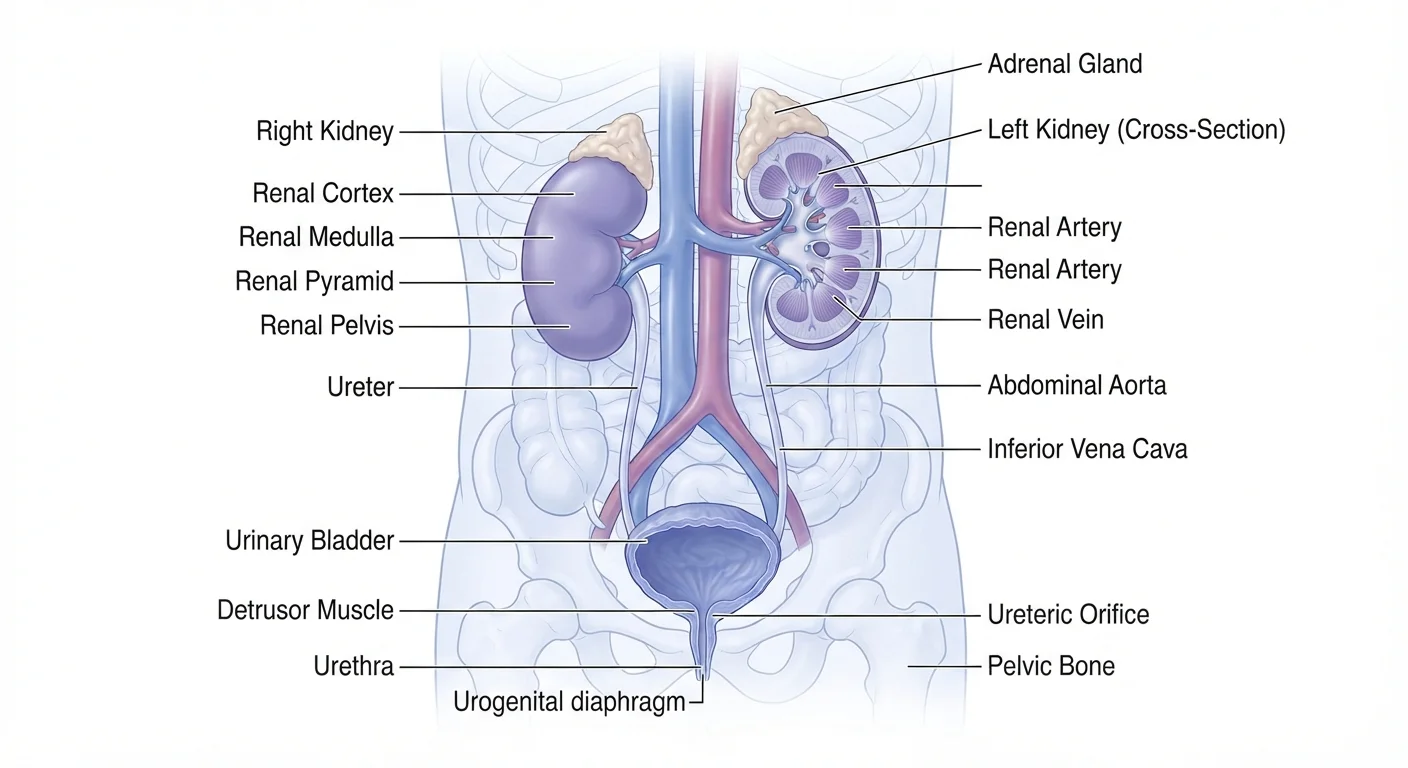
The Scale of What the Kidneys Do
Most people think of the kidneys primarily as organs that make urine - but that description barely scratches the surface. Every minute, about 1.2 litres of blood passes through the kidneys, meaning the entire blood volume of an adult circulates through these organs roughly 400 times per day. By the end of a 24-hour period, the kidneys will have processed around 180 litres of plasma - the liquid component of blood - filtering out waste while carefully preserving everything the body needs.
This is part of a broader network of remarkable background processes your body manages automatically. Just as the heart keeps beating and the lungs keep exchanging gases, the kidneys never clock off. To understand how they accomplish this feat, it helps to look at the anatomy doing the work.
180 L
Blood plasma filtered by the kidneys daily
This figure represents plasma volume filtered through the glomeruli; approximately 99% is reabsorbed before urine is formed.
~2 million
Total nephrons in a healthy adult (both kidneys)
Nephron count peaks before birth and declines slowly with age; the kidneys compensate through increased workload per unit.
1-2 L
Average daily urine output in healthy adults
Output varies significantly with hydration, diet, physical activity, and ambient temperature.
Inside the Nephron: The Body's Microscopic Filter
The kidney's functional unit is the nephron. Each kidney houses approximately one million of them, and each nephron operates as a self-contained filtration system. The process unfolds in three distinct stages:
- Filtration: Blood enters a tiny knot of capillaries called the glomerulus. Pressure forces water, salts, glucose, urea, and other small molecules out of the blood and into a surrounding cup-like structure called Bowman's capsule. Large proteins and blood cells are too big to pass through and remain in circulation. The resulting fluid - called the filtrate - is essentially blood plasma minus its proteins.
- Reabsorption: As the filtrate travels down a long tubule, the body reclaims what it needs. Nearly all glucose, amino acids, and a large proportion of water and sodium are transported back into surrounding blood vessels. This is why, despite 180 litres being filtered, only 1-2 litres leave the body as urine.
- Secretion: The tubule also actively pushes additional waste products - including certain drug metabolites and excess hydrogen ions - from the blood into the filtrate, fine-tuning pH and clearing substances that slipped through the initial filter.
The final concentrated fluid drains into the renal pelvis, travels down the ureter, and is stored in the bladder until urination.
A Simple Way to Monitor Kidney Health
Urine colour offers a rough, everyday indicator of hydration and kidney output. Pale straw-yellow typically suggests adequate hydration, while persistently dark urine may indicate concentrated waste and insufficient fluid intake. Consistently cloudy, foamy, or blood-tinged urine warrants a conversation with a healthcare provider rather than a self-diagnosis.
Beyond Filtration: The Kidney's Wider Role
Filtration is the kidneys' headline act, but these organs carry out several other critical jobs simultaneously. They produce a hormone called erythropoietin, which signals the bone marrow to make red blood cells. They activate vitamin D into its usable form, supporting calcium absorption and bone health. They also regulate blood pressure by controlling fluid volume and releasing renin, an enzyme that influences the tension of blood vessel walls.
In short, a decline in kidney function ripples across multiple body systems - which is why conditions like chronic kidney disease can affect everything from bone density to cardiovascular health. This kind of interconnected background regulation is explored further in our look at fascinating things your body does without you noticing.
Kidney Function Declines Gradually With Age
Filtration rate - measured clinically as GFR (glomerular filtration rate) - tends to decline slowly after around age 40, even in otherwise healthy adults. This is considered a normal part of ageing rather than a disease. However, it does mean that older adults may be more sensitive to medications or conditions that place extra demand on the kidneys, making periodic monitoring worthwhile.
Supporting Kidney Health
Healthy kidneys generally require little intervention to function well. The most consistent evidence supports staying adequately hydrated, maintaining blood pressure within a normal range, managing blood sugar levels (since diabetes is a leading cause of kidney damage), and avoiding prolonged or excessive use of over-the-counter pain relievers such as NSAIDs, which can stress the kidneys when taken in high amounts over time.
If you have concerns about kidney function - particularly if you notice swelling in the legs or ankles, persistent fatigue, foamy urine, or changes in urination frequency - a healthcare provider can run straightforward blood and urine tests to assess how well your kidneys are working. Early detection of any decline gives the best chance of preserving function.
This article is for general informational and educational purposes only and does not constitute medical advice. Always consult a qualified healthcare professional for concerns about your health or kidney function.