
Why Timekeeping Gets Complicated the Moment You Cross Borders
Most travelers assume time zones are a straightforward grid — move one country east, add an hour. In practice, the world's timekeeping is a patchwork shaped by colonial history, political decisions, and geographic compromise. Countries have stretched, compressed, and redrawn their clocks in ways that can genuinely disorient a traveler who isn't prepared.
Understanding these quirks isn't just geographic trivia. When you're building a travel itinerary, miscalculating a time zone offset by even half an hour can mean a missed connection or a sunrise hike that starts in full darkness. The list below covers the most counterintuitive timekeeping situations travelers encounter — and what each one means in practice.
Always verify local time manually before travel
Smartphone automatic time-zone settings rely on carrier signals, which can lag behind or default to a nearby major city's zone. Before any early-morning departure or time-sensitive appointment in an unfamiliar country, cross-check local time using a dedicated world-clock tool or your destination's official government website. This is especially important in regions with half-hour or 45-minute offsets.
The World's Strangest Timekeeping Decisions
China's single time zone across a continent-sized country
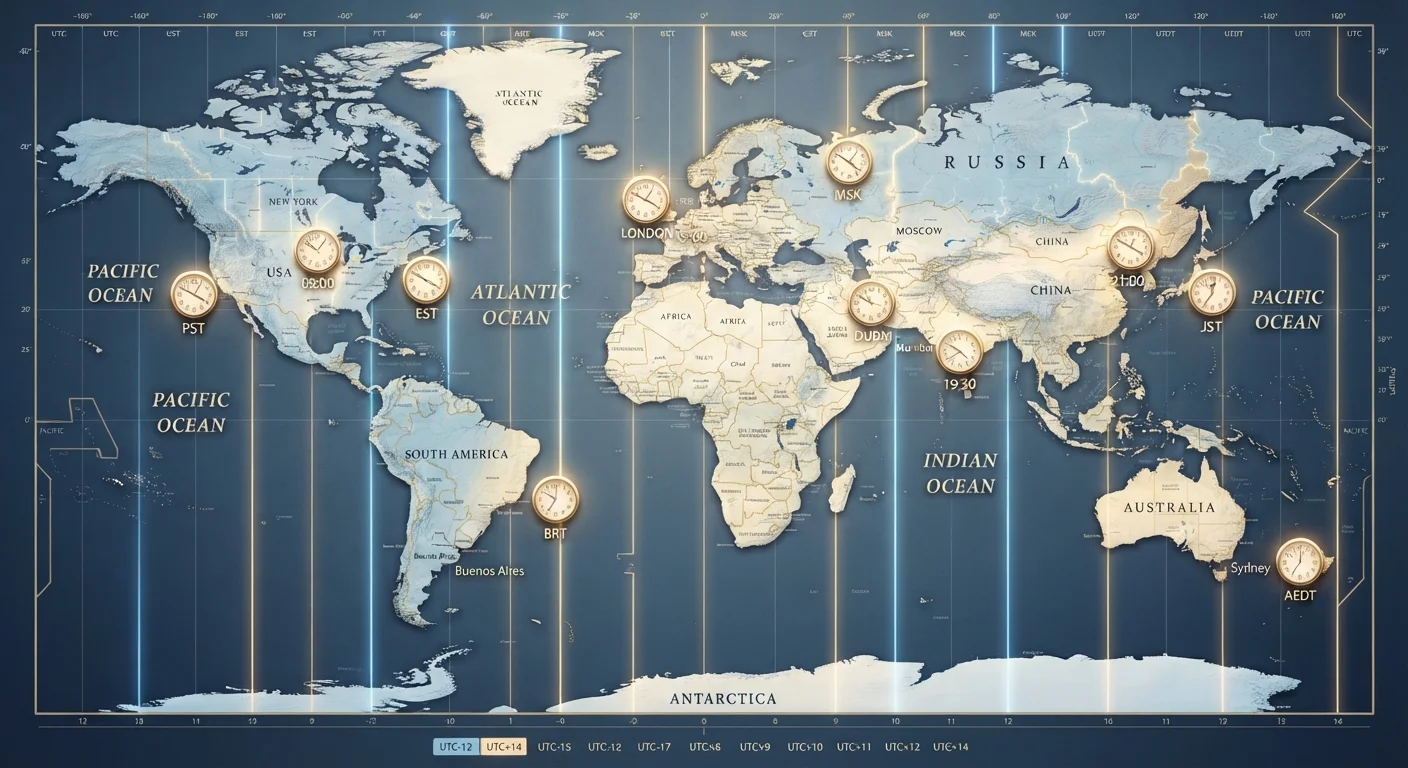
Geographically, China spans roughly five natural time zones. Yet the entire country operates on China Standard Time (UTC+8), a policy introduced in 1949 to promote national unity. The practical result is dramatic: in Xinjiang, the country's westernmost region, the sun may not rise until 10 a.m. by the clock in winter. Locals often run on an unofficial "Xinjiang time" that's two hours behind Beijing, so travelers in that region should confirm which clock a scheduled meeting, bus departure, or restaurant opening actually uses.
In Xinjiang, the sun can rise as late as 10 a.m. on the official national clock.
India's 30-minute offset and what it signals
India Standard Time sits at UTC+5:30 — a half-hour offset that immediately flags it as a country that didn't simply adopt its nearest hourly neighbor. This choice placed India at the midpoint between the time zones to its east and west, which made geographic sense for a subcontinent of its size. Half-hour offsets are more common than travelers realize: Iran (UTC+3:30), Afghanistan (UTC+4:30), and Sri Lanka (UTC+5:30) all use them. Always verify offsets rather than assuming whole-hour jumps when routing through South or Central Asia.
India's 30-minute time offset reflects a deliberate geographic compromise, not an oversight.
Nepal's 45-minute quirk — the world's oddest offset
Nepal Standard Time is UTC+5:45, making it one of only two jurisdictions in the world using a 45-minute offset (the other is the Chatham Islands of New Zealand). The offset was chosen to distinguish Nepal's time from both India's and China's, asserting a degree of national identity through timekeeping. For travelers arriving from India, this means adjusting clocks by 15 minutes — easy to overlook and surprisingly consequential for early-morning departures from Kathmandu.
Nepal's UTC+5:45 offset is one of only two 45-minute offsets used anywhere in the world.
The International Date Line and why it bends
The International Date Line (IDL) runs roughly along the 180th meridian in the Pacific Ocean, but it bends significantly to keep island groups on the same calendar day. Kiribati, for instance, pushed its section of the IDL eastward in 1995 so that all of its islands — which straddle the line — would share the same date. This makes part of Kiribati the first place on Earth to greet each new day. Travelers crossing the IDL heading westward gain a calendar day; heading eastward, they lose one. Itinerary software handles this automatically, but it's worth understanding manually when booking multi-leg Pacific routes.
Kiribati redrew the Date Line in 1995 so all its islands could share the same calendar day.
Samoa's date-line switch and its economic logic
In 2011, Samoa moved from one side of the International Date Line to the other — effectively skipping an entire calendar day (December 30 did not exist in Samoa that year). The motivation was economic: Samoa's largest trading partners, Australia and New Zealand, were operating a full day ahead of Samoa under the old arrangement. The switch aligned business hours and reduced the friction of cross-border commerce. It's a clear example of how date-line placement can be a policy choice as much as a geographic one.
Samoa skipped an entire calendar day in 2011 to align its business week with Australia and New Zealand.
Russia's 11 time zones — and the political adjustments within them
Russia officially spans 11 time zones, making it the country with the most in the world. But the zone boundaries have been adjusted multiple times for political and administrative reasons, most recently through changes in 2014 when several regions were shifted. Some Russian territories observe times that don't align with their solar position, meaning local noon can differ from solar noon by a significant margin. Travelers on Trans-Siberian Railway routes experience this dramatically, crossing zones every several hundred miles while the train runs on Moscow time internally.
The Trans-Siberian Railway runs on Moscow time internally, regardless of the local zone outside.
Australia's fractured time map — including a 30-minute zone within the country
Australia has three main time zones, but South Australia and the Northern Territory use UTC+9:30 (or UTC+10:30 during daylight saving) — another half-hour offset sitting between the eastern and western zones. This creates a situation where a domestic traveler crossing from Western Australia to South Australia adjusts by two and a half hours, not two. Add in the fact that not all Australian states observe daylight saving time, and the internal time-zone map becomes one of the more complex in the developed world for short-haul domestic travel.
Crossing from Western Australia to South Australia shifts the clock by two and a half hours, not two.
Daylight saving time adds another layer
Not all countries observe daylight saving time (DST), and those that do don't always change clocks on the same date. The United States and most of Europe shift clocks weeks apart, creating a brief annual window where the offset between them differs from its standard value. Travelers booking transatlantic flights or calls during those transition weeks should confirm exact offsets for each specific date rather than relying on memory.
Putting It All Together Before You Go
None of these quirks are reasons to avoid a destination — they're simply facts to account for when planning. A flight from the US West Coast to Fiji that crosses the International Date Line, for example, requires careful attention to arrival dates when booking ground transport or hotels. Similarly, a multi-city trip through western China or India will behave differently from what your phone's automatic time-zone feature might suggest if you're not in a major hub.
If time-zone confusion is adding to broader trip-planning uncertainty, it's worth revisiting foundational decisions — choosing a destination with an eye toward how far it sits from your home time zone can meaningfully reduce adjustment difficulty. And once you've crossed multiple zones, the recovery process is more involved than most travelers expect — jet lag affects more than just your sleep, disrupting digestion, alertness, and mood in ways tied to your circadian rhythm. Cross-checking every scheduled time against local zone rules — not just your phone's automatic setting — remains the most reliable way to stay on track.