
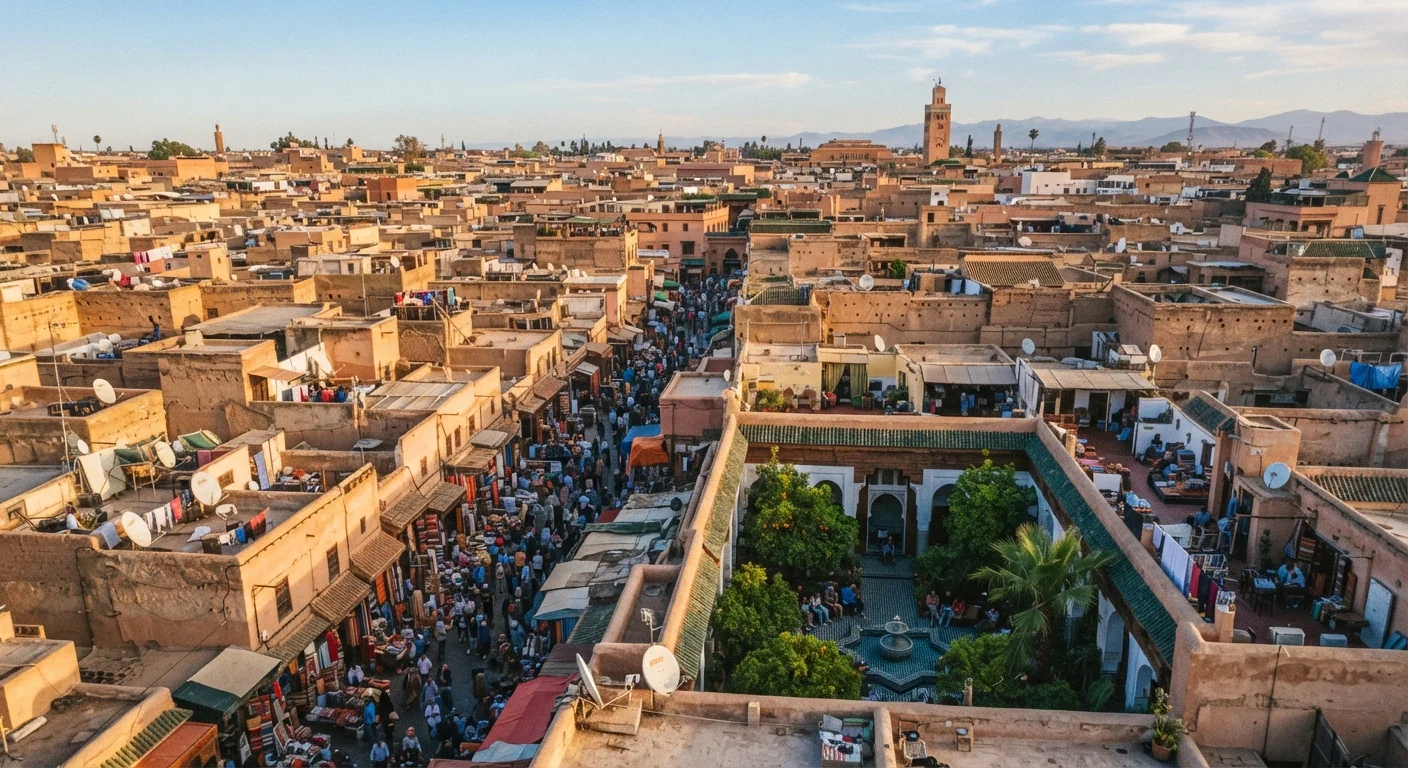
The Medina: A City Within a City
When Moroccans or guidebooks refer to "the medina," they mean the original historic city — typically enclosed by earthen or stone walls built centuries ago to define, protect, and organize urban life. Outside those walls, modern Morocco has grown: wide boulevards, apartment blocks, and commercial districts built during and after the French colonial period, known as the ville nouvelle (new town). The medina predates all of that by hundreds of years.
Inside, the layout follows an organic logic rather than a planned grid. Streets branch and narrow into covered passages called derbs — residential alleyways that served as semi-private extensions of the homes along them. Mosques, public fountains (sebils), bakeries, and hammams (bathhouses) anchor neighborhood life. A great mosque — the jami — typically marks the religious and social center of the entire medina.
Because medinas were built for foot traffic, pack animals, and handcarts, they are difficult to navigate by car. For first-time visitors, getting temporarily turned around is virtually guaranteed. This is not a flaw in the design — it reflects a planning philosophy that prioritized community and pedestrian life over speed.
Medina Boundaries Vary by City
Not every Moroccan city uses the term 'medina' in exactly the same way. In some cities, the medina is tightly defined by surviving walls and gates. In others, the historic core blends into surrounding neighborhoods with less clear physical boundaries. Travelers should check city-specific guides to understand which areas are considered historic versus modern for each destination they plan to visit.
The Souk: A Marketplace Organized by Craft
Within every medina, the souk is the commercial heart. But the word "souk" rarely refers to one single market. More accurately, it describes a system of specialized markets, each dedicated to a particular trade or product. The spice souk occupies one lane; the dyers' souk, the leather souk, the coppersmith souk, and the textile souk each claim their own territory.
This organization by craft is not accidental. Medieval Islamic urban planning placed noisier, messier, or more pungent trades — tanneries, forges — at the edges of the commercial district, while trades considered more refined, such as booksellers or perfumers, were positioned closer to the central mosque. Walking through a souk is, in effect, walking through a living map of that ancient commercial hierarchy.
9,400+
Streets and alleyways in Fez's medina
Fes el-Bali is frequently described by urban historians as one of the world's largest car-free urban zones, with a street network that has remained largely intact for over a millennium.
4
Moroccan medinas on UNESCO World Heritage list
The medinas of Fez, Marrakech, Meknes, and Essaouira have all been designated UNESCO World Heritage Sites in recognition of their outstanding universal cultural value.
~1,000
Years of continuous habitation in Fes el-Bali
Founded in the 9th century CE, Fez's historic medina is considered one of the oldest continuously inhabited medieval cities in the world, according to historical and archaeological records.
What visitors experience today — the sensory density, the narrow corridors, the piled saffron and stacked babouches (leather slippers) — closely resembles what travelers and merchants encountered centuries ago. The physical form of the souk has proven remarkably durable.
The Riad: Architecture Turned Inward
A riad (from the Arabic ryad, meaning garden) is a traditional Moroccan townhouse built around a central open courtyard. The defining characteristic is its orientation: rather than presenting windows or gardens to the street, the riad faces inward. From the outside, a riad's door may be unassuming or even modest. Step inside, and the architecture opens up entirely — tiled fountains, orange trees, carved stucco screens, and layered galleries rising two or three stories.
This inward design reflects both the climate and the cultural values of private life. Thick walls and a shaded interior courtyard keep the home cool during North Africa's hot summers. The design also kept family life, and especially the lives of women, shielded from the public street.
What to Look For When Visiting a Riad
When exploring or booking a riad, look for the key architectural features: a central courtyard (open to the sky), a fountain or water feature, zellige tilework on lower walls, carved plaster (stucco) panels above, and painted cedarwood ceilings or screens. These elements are markers of authentic traditional construction. Modern imitations exist but typically lack the craftsmanship depth of historic riads.
Over the past few decades, many riads — particularly in Marrakech and Fez — have been purchased, restored, and converted into guesthouses. For travelers, staying in a riad offers a direct encounter with this architectural tradition. Standards and quality vary widely, so researching specific properties carefully before booking is advisable.
How These Three Elements Connect
Medina, souk, and riad are not independent curiosities — they are three layers of the same urban system. The medina provides the outer frame: the walls, the gates, the street network. The souk fills its commercial center with economic life. The riad houses the families and individuals who animate the whole city.
Understanding how they relate changes the experience of traveling through a Moroccan city. A walk through the medina is not simply sightseeing — it is moving through a functioning urban environment whose spatial logic has been refined over nearly a thousand years. The souk is not a tourist bazaar but the continuation of a trade infrastructure that once connected Morocco to sub-Saharan Africa, al-Andalus, and the broader Islamic world. The riad is not just a picturesque hotel option but a window into how privacy, beauty, and family life were physically organized in urban Morocco.
Travelers who arrive with even a basic grasp of these concepts tend to navigate more confidently, engage more respectfully, and leave with a richer understanding of the places they visited.