
Why Traditional Greetings Matter to Travelers
When you arrive in Thailand, Indonesia, or India, the first social exchange you're likely to encounter isn't a handshake — it's a gesture, a posture, or a spoken phrase that carries centuries of meaning. For travelers, understanding what these greetings actually communicate goes beyond good manners. It signals respect, builds trust, and opens doors that a casual wave simply cannot.
Three greetings, in particular, come up most frequently for visitors to the region: the Thai wai, the South Asian namaste, and the Arabic-rooted salam used across Muslim-majority parts of Southeast Asia. Each one is distinct in its origins, its social rules, and what it expresses. Knowing the difference helps you respond appropriately — and avoid unintentional disrespect.
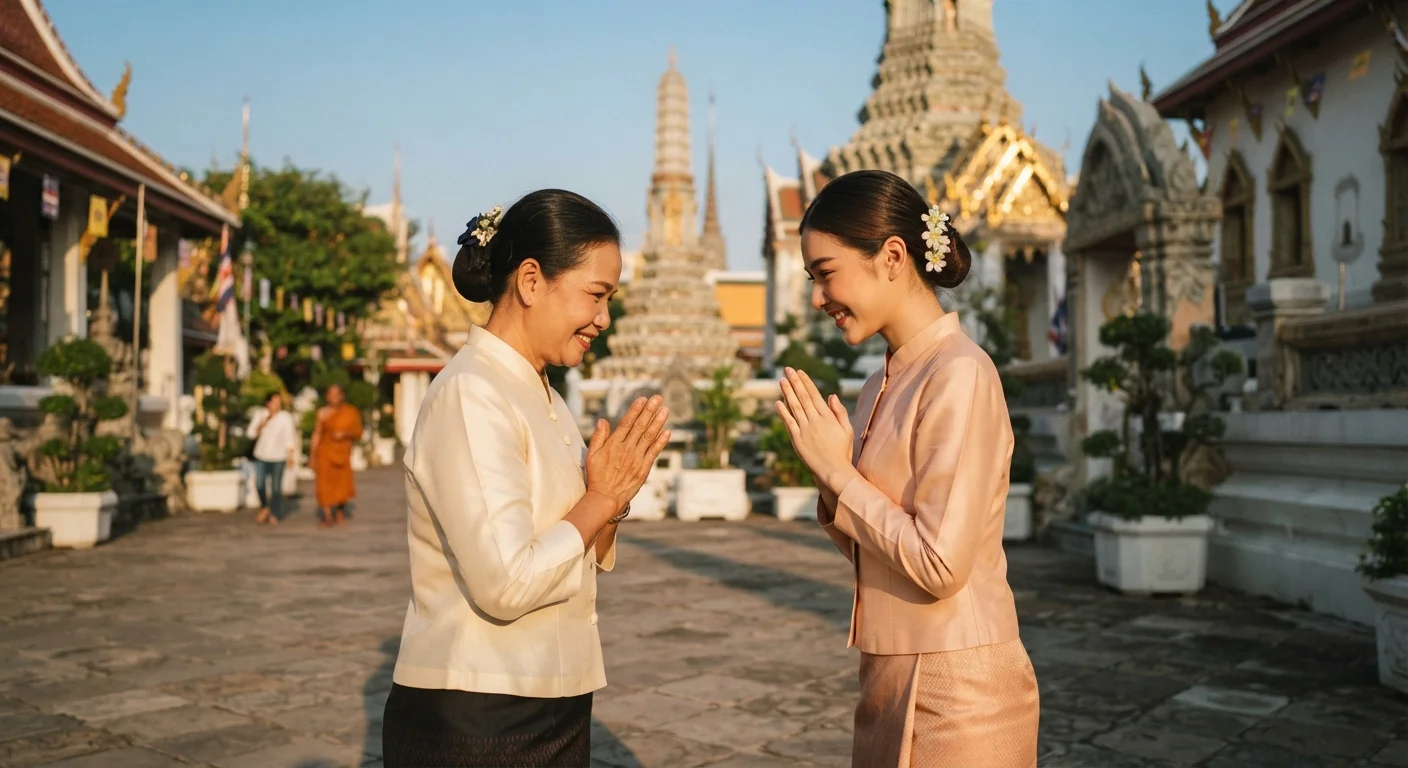
Wai
The traditional Thai greeting performed by pressing both palms together at chest or face level and bowing the head. The height of the hands signals the degree of respect being shown.
Namaste
A Sanskrit greeting used in India, Nepal, and Hindu communities broadly. It combines a pressed-palm gesture (anjali mudra) with a slight bow, expressing mutual reverence.
As-salamu alaykum
An Arabic Islamic greeting meaning "Peace be upon you," used across Muslim-majority communities worldwide including much of Southeast Asia. The standard response is "Wa alaykum assalam."
Anjali Mudra
A Sanskrit term for the gesture of pressing the palms together at the heart or forehead level, used in namaste and related Hindu and Buddhist traditions as a sign of respect.
Sampeah
The Cambodian equivalent of the Thai wai — a pressed-palm bow whose height and depth indicate the relative social status of the person being greeted.
Salam
A shortened, commonly used form of the Muslim greeting As-salamu alaykum. It literally means "peace" and functions as a prayer for wellbeing directed toward another person.
The Wai: Thailand's Gesture of Reverence
The wai (ไหว้) is performed by pressing the palms together at chest level, fingertips pointing upward, and bowing the head slightly. It is the standard greeting in Thailand and is also used in Laos, Cambodia (where it's called the sampeah), and Myanmar. But the wai is not one-size-fits-all — its meaning and execution shift depending on the social hierarchy involved.
| Countries Where Wai Is Used | Thailand, Laos, Cambodia, Myanmar |
| Meaning of 'Wai' | Respect, greeting, gratitude, or apology depending on context |
| Hand Height for Monks (Wai) | Forehead level — the highest form |
| Namaste Language of Origin | Sanskrit |
| Countries Where Salam Is Primary Greeting | Malaysia, Indonesia, Brunei |
| Response to As-salamu alaykum | Wa alaykum assalam ("And upon you, peace") |
- To elders and monks: Hands are raised higher, sometimes to nose or forehead level, with a deeper bow. The higher the hands, the greater the respect shown.
- Between peers: Hands meet at chest level with a gentle nod.
- To children or subordinates: A Thai person of higher status typically returns a lower wai or simply nods.
Travelers are not expected to initiate the wai perfectly, but returning one when offered is considered polite. Notably, the wai is also used to say thank you, to apologize, and to say goodbye — context and body language clarify which message is meant.
Namaste: More Than a Yoga Studio Staple
In India, Nepal, and among Hindu communities throughout Southeast Asia, namaste (नमस्ते) is the everyday greeting. Like the wai, it involves pressing the palms together — a gesture called the anjali mudra — combined with a slight bow and the spoken word. The word itself is Sanskrit: namas means "bow" or "reverence," and te means "to you."
Culturally, namaste expresses the idea that the divine or the essential self in one person acknowledges the same in another. While this spiritual dimension is genuine, the greeting is also used casually and warmly between strangers, in markets, and in professional settings. It functions as both "hello" and "goodbye."
Regional Variations Within Countries
India, Indonesia, and even Thailand encompass enormous regional and ethnic diversity. While namaste, wai, and salam are widely recognized greetings in their respective countries, local communities may have distinct greeting customs layered on top of these. In Bali, for instance, the Balinese Hindu greeting "Om Swastiastu" is preferred in ceremonial contexts. Travelers benefit from researching the specific region they are visiting, not just the country.
In practice, namaste is used across India's diverse regions, though specific regions have their own greeting variations. In some communities, touching the feet of elders is a sign of deep respect that goes beyond namaste. As a visitor, offering namaste with a genuine nod is almost universally well-received.
Salam: A Verbal Blessing Across Borders
In Malaysia, Indonesia, Brunei, and among Muslim communities throughout the Philippines and southern Thailand, the greeting As-salamu alaykum (السلام عليكم) — often shortened to salam — is the standard Muslim hello. It translates directly as "Peace be upon you," and the expected response, Wa alaykum assalam, means "And upon you, peace."
This greeting carries religious weight: it is a prayer for wellbeing directed at another person. Among Muslim communities, it is considered a form of charity to offer salam first. In more formal or devout settings, it may be accompanied by placing the right hand over the heart.
270M+
Muslims in Indonesia alone
Indonesia has the world's largest Muslim population, making salam the most widely used daily greeting in the country.
1.4B+
People in India where namaste is common
Namaste is used as a standard greeting across India's vast and diverse population, spanning multiple languages and regions.
Non-Muslim travelers are generally not expected to initiate salam, and doing so without understanding its context can occasionally feel out of place. However, learning the response and using it when greeted is appreciated. In Indonesia and Malaysia especially, a warm selamat pagi ("good morning") in Bahasa is an accessible, respectful alternative for visitors.
How to Respond as a Visitor
No cultural greeting requires perfection from foreign visitors — what matters most is genuine effort and attentiveness. A few practical principles apply broadly across all three:
- Observe first: Watch how locals greet each other before jumping in. Social cues tell you whether a formal or casual response is appropriate.
- Mirror the gesture: If someone offers you a wai, wai back. If someone says salam, respond with the peace phrase or at minimum acknowledge it warmly.
- Mind gender norms: In many Muslim-majority contexts, physical contact between unrelated men and women may not be customary. Wait to see if a hand is extended before offering yours.
- Don't over-perform: Exaggerated or theatrical greetings can read as mockery rather than respect. Simple and sincere is always better.
Understanding that these greetings are social contracts — expressing hierarchy, goodwill, and spiritual acknowledgment all at once — transforms them from awkward moments into meaningful connections. Travelers who make the effort consistently report warmer, more authentic interactions throughout their journeys.
U.S. Department of State Country Information Pages
Official government pages for each country include cultural notes, entry requirements, and safety advisories. A reliable starting point for understanding local customs and any travel considerations before your trip.
BBC Languages: Cultural Etiquette Guides
The BBC's archived language and culture resources offer accessible introductions to greeting customs and social norms in many countries, useful for building baseline cultural awareness before travel.