
How Many Languages Does Sub-Saharan Africa Have?
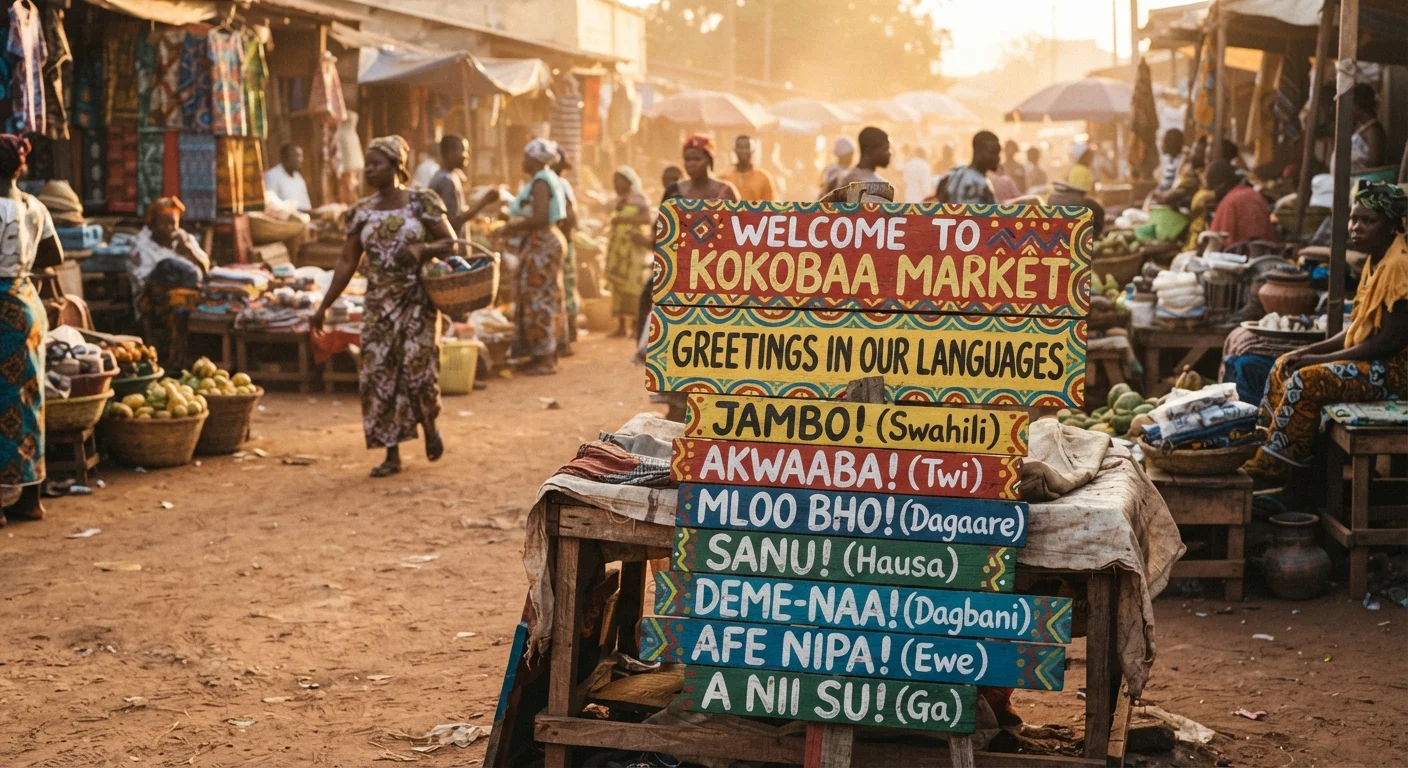
Sub-Saharan Africa — the part of the continent south of the Sahara Desert — is home to an estimated 1,500 to 2,000 languages, depending on how researchers draw the line between a distinct language and a dialect. That figure represents roughly one-third of all languages spoken on Earth, packed into a region of about 50 countries.
For travelers, this breadth has a practical meaning: crossing a single national border — or sometimes driving a few hours within one country — can bring you into contact with an entirely different linguistic world. Nigeria alone is estimated to have over 500 languages. Tanzania has more than 120. Understanding this diversity before you travel helps set realistic expectations and deepens appreciation for the communities you visit.
The Major Language Families
Linguists group Sub-Saharan Africa's languages into four broad families. Knowing these families helps you recognize connections between languages that may seem unrelated at first glance.
Niger-Congo
The largest language family in Africa by number of languages and speakers. It includes the extensive Bantu branch, which covers much of sub-equatorial Africa, and major West African languages such as Yoruba and Igbo.
Bantu languages
A large sub-branch of Niger-Congo languages sharing common grammatical features and vocabulary roots. Swahili, Zulu, Shona, and Lingala are all Bantu languages spoken across Central, East, and Southern Africa.
Lingua franca
A shared language used for communication between speakers whose native languages are different. In Sub-Saharan Africa, Swahili and Hausa function as regional lingua francas.
Khoisan languages
A grouping of languages spoken primarily in Southern Africa, best known for their use of click consonants as standard speech sounds. They are spoken by San and Khoikhoi communities.
Afroasiatic
A language family that spans North Africa and the Horn of Africa. It includes Amharic, the official language of Ethiopia, and Somali, among others present in Sub-Saharan contexts.
Nilo-Saharan
A diverse grouping of languages found across the Sahel belt and East Africa, including Dinka, Luo, and Kanuri. It is less genetically unified than Niger-Congo but widely recognized as a classification category.
- Niger-Congo: The largest family by number of languages and speakers. It includes the Bantu branch — which spans much of Central, East, and Southern Africa — as well as West African languages such as Yoruba, Igbo, and Fula.
- Afroasiatic: Extends from North Africa into the Horn of Africa. Amharic (Ethiopia) and Somali are prominent examples in the sub-Saharan zone.
- Nilo-Saharan: A diverse grouping found across the Sahel and East Africa, including Dinka, Luo, and Kanuri.
- Khoisan: A cluster of languages spoken primarily in Southern Africa, known for distinctive click consonants. San (Bushman) languages belong to this grouping.
Colonial-era borders frequently cut across language territories, which is why a single language like Hausa can be a mother tongue for millions of people across several different countries.
Lingua Francas: The Languages That Connect Regions
Because no single language unites the region, lingua francas — shared bridge languages — play a vital everyday role. Several have spread across hundreds of miles and multiple borders.
150–200M
Swahili speakers across East & Central Africa
Commonly cited estimate from African Union and linguistic research organizations.
500+
Languages spoken within Nigeria alone
According to Ethnologue's catalogue of Nigerian languages, 26th edition.
11
Official languages recognized in South Africa
South Africa holds the highest number of constitutionally recognized official languages of any country in the world.
- Swahili (Kiswahili): The most widely used African lingua franca, spoken as a first or second language by an estimated 150–200 million people across East Africa and parts of Central Africa. It is an official language in Tanzania, Kenya, Uganda, Rwanda, and the Democratic Republic of Congo.
- Hausa: A major trade and communication language across West Africa, particularly in Nigeria, Niger, Ghana, and Cameroon.
- Lingala: Widely spoken in the DRC and Republic of Congo, including as the language of much popular music across the continent.
- Zulu and Xhosa: Among South Africa's 11 official languages, these are spoken by large portions of the population and widely understood in urban centers.
European languages — particularly English, French, and Portuguese — remain official languages in many countries, inherited from the colonial period. They function as administrative and educational languages, though for most residents they are not mother tongues.
What This Means for Travelers on the Ground
Practically speaking, a few phrases of a regional lingua franca go a long way. Learning basic greetings in Swahili before visiting East Africa, or in French before heading to Francophone West Africa, signals genuine respect and often opens conversations that English alone would not.
In cities and tourist areas, English or French is commonly understood in service settings, but rural areas may rely entirely on local languages. Hiring a local guide is not just convenient — it is frequently the only effective way to communicate with communities off the main routes.
Written signage varies enormously. In Ethiopia, Amharic uses the Ge'ez script (also called Ethiopic), which is visually distinct from the Latin alphabet. Arabic script is used for Somali in some contexts. Many Bantu languages, however, are written in the Latin alphabet, making pronunciation attempts easier for English-speaking travelers.
Translation apps can help in a pinch, but coverage for lesser-resourced African languages remains limited. Offline phrasebooks and locally published language guides are often more reliable in areas with poor internet connectivity.
Most importantly, approach linguistic diversity with curiosity rather than frustration. Asking a local how to say a word correctly is one of the most reliable ways to start a genuine conversation anywhere in Sub-Saharan Africa.