
What a Bank Statement Actually Is
A bank statement is an official record your bank produces - typically once a month - summarizing every transaction in your account during that period. It isn't a bill and it isn't a budget; it's a ledger that shows exactly what happened to your money. Most people receive them digitally through online banking portals, though paper versions are still available on request.
Understanding your statement is a foundational money skill. It's the starting point for tracking your spending, building a working budget, and catching problems before they grow. If you've ever felt uncertain looking at one, you're not alone - but the format is more logical than it first appears.
What you will need
Tools You'll Need
You don't need special software to read a bank statement. The items below are all you'll typically use:
Bank statement (paper or PDF)
The primary document you'll be reading and cross-checking line by line.
Online banking portal or mobile app
Allows you to verify real-time balances and pull up transaction details not visible on a printed statement.
Highlighter or annotation tool
Mark unfamiliar or suspicious transactions as you work through the statement.
Once you have your statement in hand, the step-by-step process below walks you through each part in order.
How to Read Your Statement, Step by Step
Follow these steps each time you review a new statement. With practice, the whole process takes under 15 minutes.
Locate the account summary section
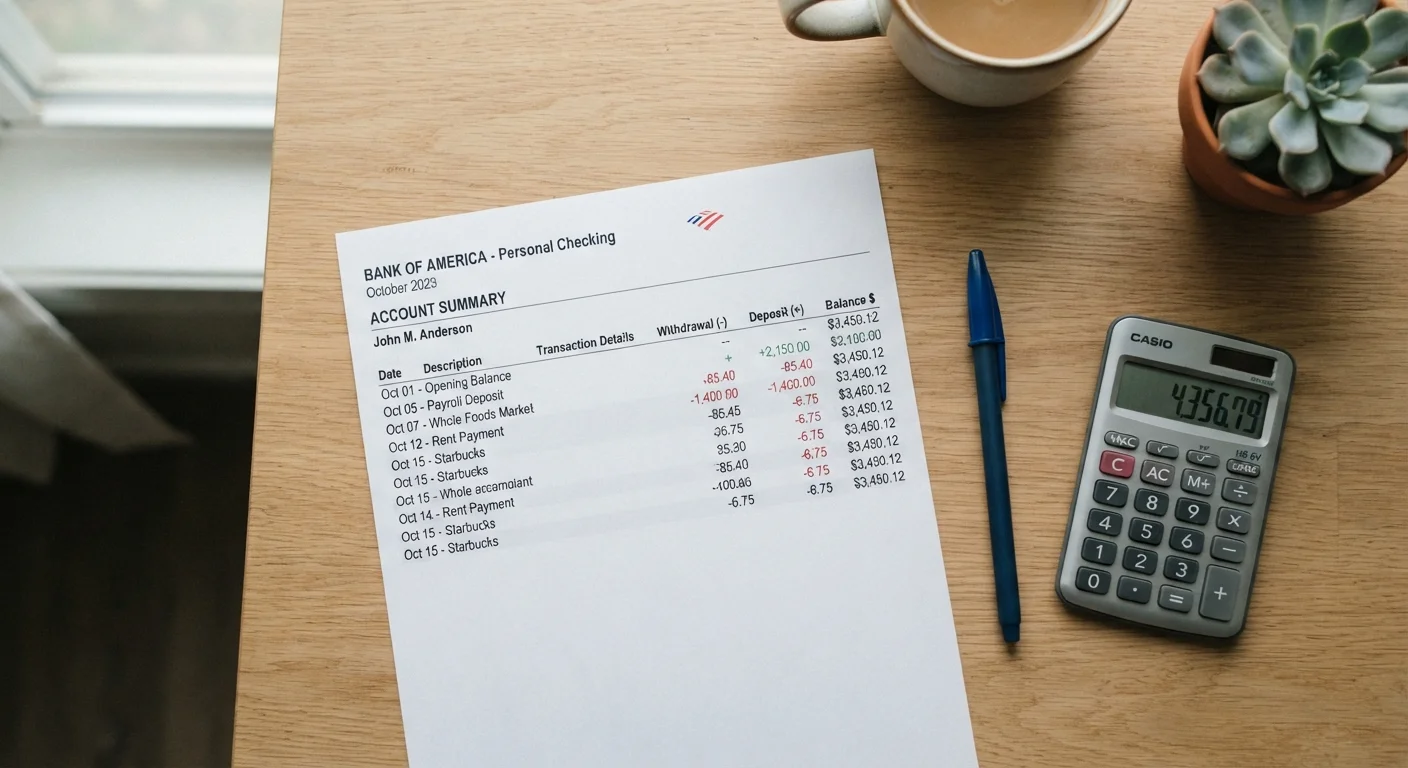
At the very top of most bank statements you'll find an account summary block. This shows your account number (usually partially masked for security), the statement period (e.g., June 1-June 30), your opening balance - what you had at the start of the period - and your ending balance - what remained at the close. These two figures are your anchors for everything else on the page.
Understand debits and credits
Every transaction on your statement is classified as one of two things. A debit reduces your balance - this includes purchases, ATM withdrawals, bill payments, and bank fees. A credit increases your balance - this includes direct deposits, refunds, and interest earned. Banks display these in separate columns or use positive and negative numbers, depending on their format. Get comfortable identifying which column is which before reading individual transactions.
Read through the transaction list
Work through every transaction chronologically. For each line, note the date, the description (merchant name, transfer label, or fee type), and the amount. Flag anything that looks unfamiliar. Common entries include:
- POS purchase - a point-of-sale card transaction at a retailer
- ACH debit/credit - electronic transfers, often recurring subscriptions or payroll deposits
- Wire transfer - larger transfers between banks
- Service charge or maintenance fee - a regular fee your bank charges for account upkeep
- Overdraft fee - charged when your balance dropped below zero
Verify your ending balance
Once you've reviewed all transactions, confirm that the math adds up: opening balance + all credits − all debits = ending balance. Banks rarely make arithmetic errors, but checking this yourself helps you understand exactly how your balance moved during the month. Compare the ending balance to what your online banking app currently shows - keeping in mind that very recent transactions may not yet appear on your closed statement.
Check for fees, interest, and recurring charges
Scan specifically for monthly maintenance fees, ATM fees, overdraft fees, and - on interest-bearing accounts - interest earned. Fees can quietly erode your balance over time. If you're being charged a monthly maintenance fee, review whether your account terms offer a fee waiver (many banks waive it if you maintain a minimum balance or have a qualifying direct deposit). For savings accounts, note the interest credited - even small amounts confirm your money is working as expected.
Flag and report anything suspicious
If any transaction is genuinely unrecognized after reasonable investigation, contact your bank's customer service line - the number is printed on your statement. Ask them to clarify the charge or open a dispute if necessary. Keep a record of when you called and what was discussed. Acting quickly is essential, as consumer protections are time-limited.
Report Errors or Fraud Promptly
Federal consumer protections generally require you to report unauthorized transactions within specific time windows to limit your liability - often 60 days from when the statement was sent. If you spot a charge you don't recognize, contact your bank immediately and do not wait. Delays can reduce the protection you're entitled to under the Electronic Fund Transfer Act.
Putting Your Statement to Work
Reading your statement is just the beginning. Once you know where your money went, you can make smarter decisions going forward. Categorizing your debits - groceries, utilities, dining, subscriptions - gives you a clear picture of spending patterns. This feeds directly into understanding your real monthly cash flow and is one of the most effective first steps toward financial clarity.
Set a Monthly Statement Review Date
Pick one specific day each month - the day after your statement closes works well - to sit down and review every line. Making it a calendar habit takes less than 15 minutes and dramatically reduces the chances of missing a fraudulent charge or an unexpected fee. Pair this with a broader spending review using our monthly cash flow guide.
Don't Assume Your Balance Is Always Spendable
Your ending balance may include pending holds - such as a hotel authorization or a recent check deposit that hasn't fully cleared. Spending right up to your stated balance can trigger overdraft fees. Always account for any outstanding transactions before making large purchases.
If you want to build on this foundation, the monthly financial health check pairs a statement review with a look at your savings progress and credit standing - a practical routine for anyone taking their finances more seriously. You can also explore saving and credit basics to understand how your bank account activity connects to your broader financial picture.
This article is for general informational and educational purposes only and does not constitute personalised financial advice. For guidance specific to your situation, consider consulting a qualified financial professional.