
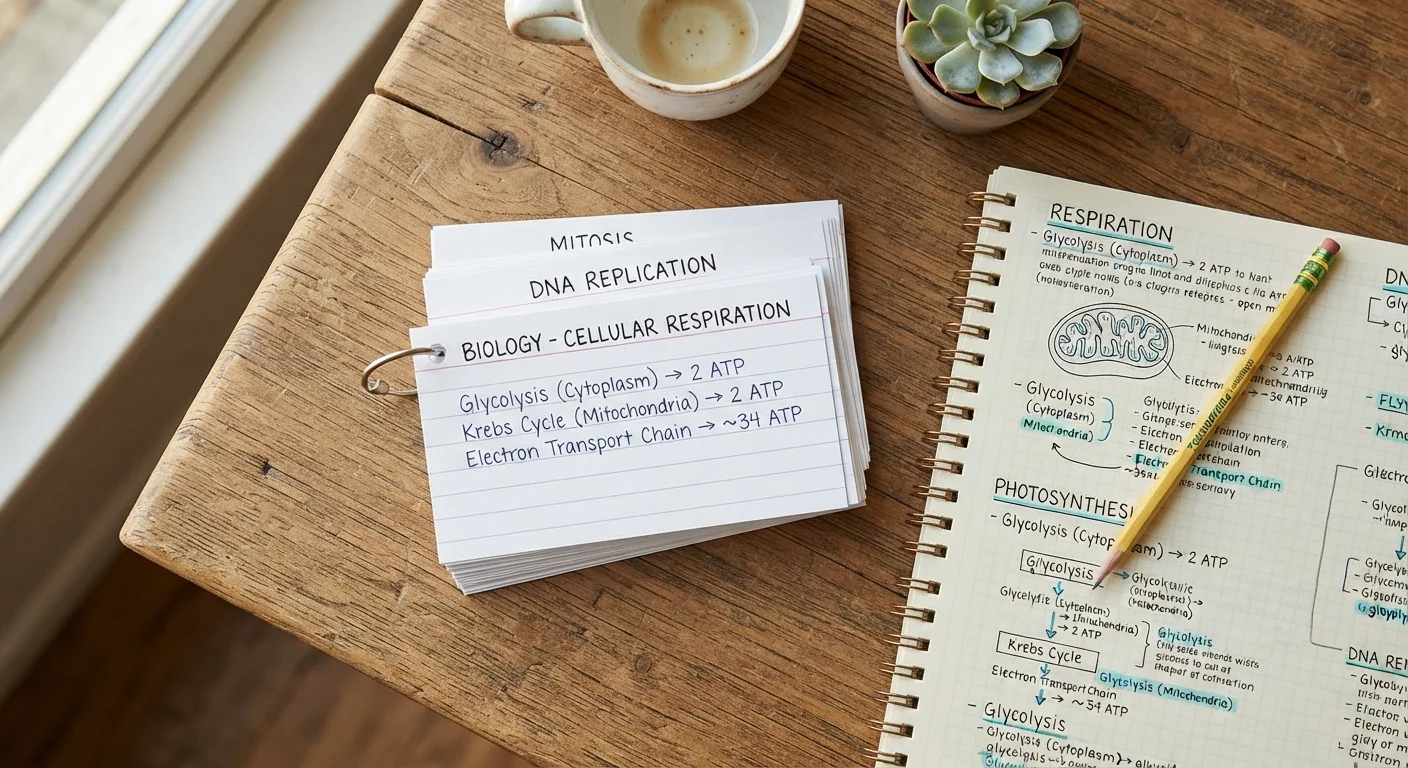
Why Most People Use Flashcards Wrong
Flashcards have been a study staple for generations, but owning a deck is not the same as using one well. The most common mistake is passive review: flipping through cards, reading the answer, and moving on. This feels productive, but it bypasses the one mechanism that actually builds memory - the effort of retrieval.
Research consistently shows that trying to remember something, rather than re-exposing yourself to it, is what cements knowledge in long-term memory. Used correctly, flashcards are a practical tool for applying this principle. Used passively, they are little more than expensive bookmarks. For a broader look at evidence-ranked strategies, see how flashcards compare to other study methods.
Best Practices for Writing and Organising Your Cards
Good flashcard use starts before you ever begin reviewing. How you write and arrange cards shapes whether the tool works at all.
Write one question per card, targeting a single fact or concept.
Cramming multiple ideas onto one card forces passive reading rather than active retrieval. Single-idea cards make it immediately clear whether you know something or not, which is where the real learning happens.
Use your own words, not copied text, when writing card answers.
Paraphrasing requires you to process the material at a deeper level, a principle cognitive scientists call elaborative encoding. Cards copied verbatim from a textbook encourage surface-level recognition rather than true understanding.
Apply spaced repetition by reviewing cards at gradually increasing intervals.
Memory strengthens most when you revisit material just as it starts to fade. Reviewing too soon wastes time; waiting too long loses the trace entirely. Spacing reviews exploits the brain's natural consolidation process. See the cognitive research behind spaced repetition for a deeper explanation.
Always attempt to retrieve the answer before flipping the card.
The act of trying to recall - even unsuccessfully - strengthens the neural pathway more than simply reading the answer does. This technique, known as active recall, is consistently rated among the highest-impact study strategies in learning research.
Sort cards into confidence categories after each session.
Not all cards deserve equal review time. Spending time on cards you already know well is a common efficiency drain. Sorting into 'know well,' 'shaky,' and 'don't know yet' lets you concentrate effort where it will have the most impact.
Shuffle your deck every session to prevent order-dependent memory.
When cards are always reviewed in the same sequence, the brain begins using positional cues rather than actual knowledge to retrieve answers - a subtle but significant shortcut that fails on tests.
Digital vs. Paper Flashcards
Both formats can be effective when used correctly. Digital apps that build spaced repetition scheduling in automatically can reduce the planning burden for busy learners. Paper cards, however, engage handwriting and tactile memory in ways that may reinforce encoding. Choose the format you will actually use consistently - consistency outweighs format.
Reviewing Cards the Right Way
The review process is where most learners leave real learning gains on the table. Active, spaced, and confident review transforms a passive habit into one of the most effective study techniques available. The science behind spacing effects is explored in depth at the science behind spaced repetition.
“The testing effect is one of the most robust findings in cognitive psychology. Retrieving information from memory is not just a measure of learning - it is itself a powerful learning event.”
— Henry Roediger III, Cognitive psychologist and memory researcher at Washington University in St. Louis
Pair these habits with a well-structured overall session - building a study session that actually sticks offers a practical framework for doing exactly that. And if you find yourself cramming cards the night before an exam, understand why that approach undermines durable memory - and what to do instead.
~50%
More information retained with spaced practice vs. massed practice
A widely cited review by Cepeda et al. (2006) in Psychological Bulletin found distributed practice produced roughly double the retention of massed (cramming) study for the same total study time.
2x
Recall advantage of retrieval practice over re-reading
Research by Roediger and Karpicke (2006) demonstrated that students who practiced retrieval recalled significantly more material one week later compared to those who restudied the same content.
Start Improving Your Flashcard Habit Today
The gap between adequate flashcard use and excellent flashcard use is mostly a matter of deliberate habit rather than time. Small adjustments - one idea per card, genuine retrieval attempts, spaced scheduling - compound quickly into measurably better retention.
For a full overview of how these principles fit into a broader study toolkit, explore spaced repetition, active recall, and the Feynman Technique as a unified field guide.
Make Questions Harder, Not Easier
A common mistake is writing cards with answers that are too obvious - so easy they never truly challenge recall. Push yourself to include cards that ask for application or explanation, not just definitions. If you can answer every card in your deck in under two seconds, the deck is probably too easy to drive meaningful learning.