
How Each Format Is Structured
Understanding what each system actually looks like helps you apply it correctly rather than just loosely imitating it.
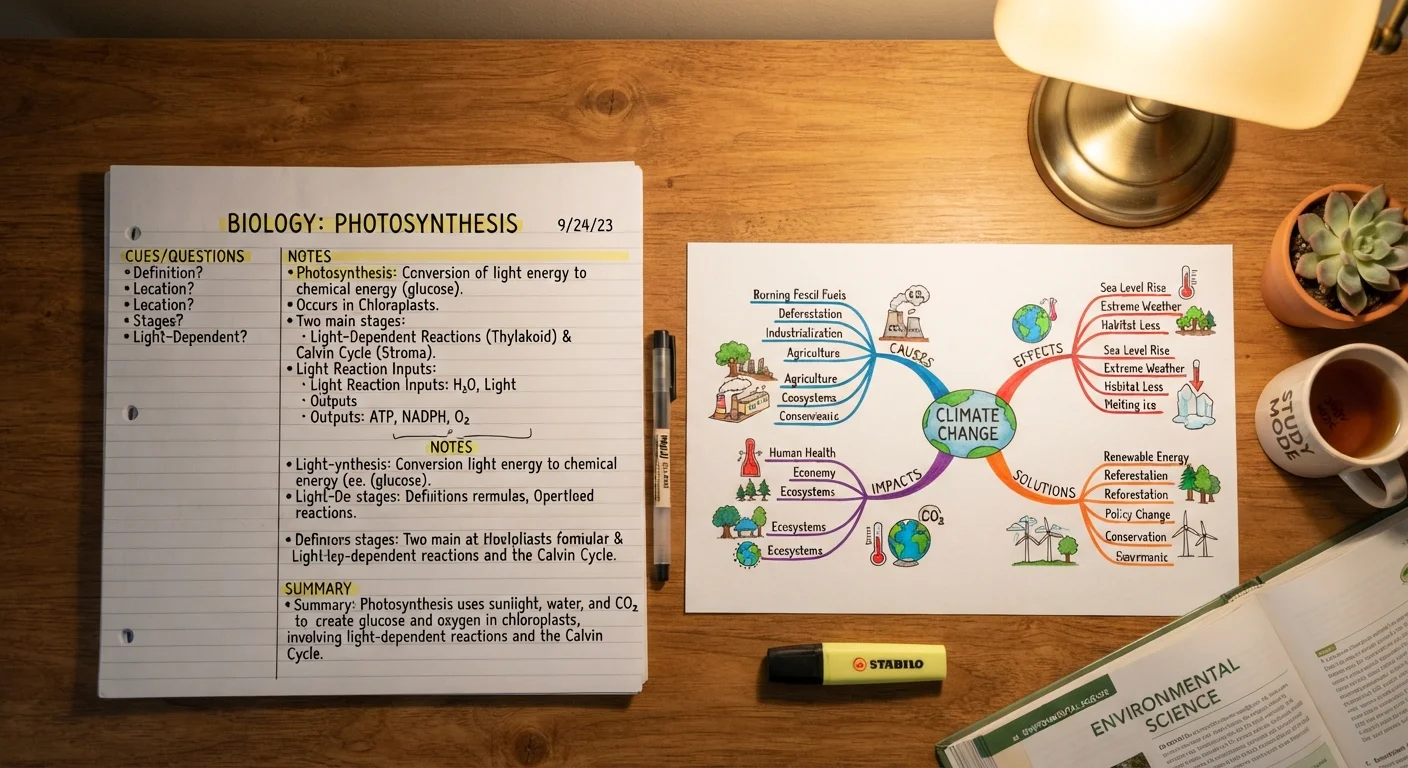
Cornell Notes divide a page into three zones: a narrow left-hand cue column, a wide right-hand notes column, and a summary box at the bottom. During a lecture or reading, you write detailed notes on the right. Afterward, you distill key questions or keywords into the cue column - these act as prompts during self-testing. The bottom summary, written in your own words, cements understanding. This three-stage process (capture, compress, summarize) mirrors the principles behind active recall and elaborative interrogation, both of which are well-supported in learning science research.
Mind Mapping starts with a central topic placed in the middle of the page. Branches radiate outward to represent main ideas, and sub-branches add supporting details, examples, or related concepts. The result is a web-like diagram that makes hierarchical and associative relationships visible simultaneously. Pioneered in widespread educational use from the 1970s onward, mind maps draw on the brain's preference for associating information rather than storing it in isolated chunks.
For a broader look at how these and other systems compare, see note-taking methods every student should know.
| Criterion | Cornell Notes | Mind Mapping |
|---|---|---|
| Page layout | Three structured zones (cues, notes, summary) | Radial branches from a central topic |
| Best subject type | Sequential, fact-dense content | Conceptual, interconnected topics |
| Supports self-testing | Yes - cue column acts as a quiz prompt | Indirectly - requires additional effort |
| Captures fine detail | Strong - linear format suits specifics | Weaker - detail can clutter branches |
| Shows idea relationships | Limited - sequential, not associative | Strong - connections are visually explicit |
| Suited to brainstorming | No | Yes - open structure encourages ideation |
| Works well for exam prep | Yes - built-in recall mechanism | Good for overview; supplement with details |
| Ease of use during a lecture | High - structured layout speeds capture | Moderate - requires spatial planning |
Strengths, Weaknesses, and When to Switch
Neither format is universally superior - each has a clear zone of effectiveness.
~50%
Retention boost from retrieval practice
Research published in cognitive psychology literature consistently shows that self-testing after learning improves recall by roughly 50% compared to passive re-reading.
2x
Concepts recalled with structured notes
Studies on organized note-taking formats suggest learners using structured systems recall approximately twice as many key concepts on delayed tests versus unorganized notes.
Cornell Notes shine when the source material is structured and sequential - think textbook chapters, science lectures, or history timelines. The system's built-in review mechanism is one of its greatest strengths: research consistently shows that testing yourself on material shortly after learning it (retrieval practice) improves long-term retention more than re-reading. The cue column makes that retrieval practice almost automatic. The weakness is rigidity: for creative or exploratory thinking, forcing ideas into a linear format can stifle connections before they form.
Mind maps are most powerful when the goal is to see a subject as an interconnected whole. Subjects with many overlapping themes - literature, sociology, project planning - lend themselves to a radial layout. Mind maps also work well as a consolidation tool: after a week of Cornell notes on a topic, drawing a mind map can reveal gaps and links you hadn't noticed. Their limitation is detail: complex factual information (specific equations, precise dates, step-by-step procedures) becomes hard to read in a map format and is better handled linearly.
A practical hybrid approach: use Cornell Notes to capture during class or reading, then build a mind map afterward as a synthesis exercise. This pairs the capture strength of one method with the conceptual overview of the other. To make either method work within your broader routine, see how to build a study session that actually sticks.
Digital vs. Handwritten: Does It Matter?
Both Cornell Notes and mind maps can be created digitally or by hand. Research from cognitive science suggests that handwriting - because it forces paraphrasing - may support deeper encoding for fact-heavy material. Digital tools, however, offer advantages for reorganizing, searching, and sharing notes. The format you choose (Cornell or mind map) matters more than the medium; select whichever medium you'll actually maintain consistently.
If you are managing multiple subjects simultaneously, the format you choose for each one matters. Heavy-content subjects like chemistry or law often reward Cornell Notes; broader, discussion-based subjects reward mind maps. Learn more about distributing your energy across courses in managing study time across multiple subjects.