
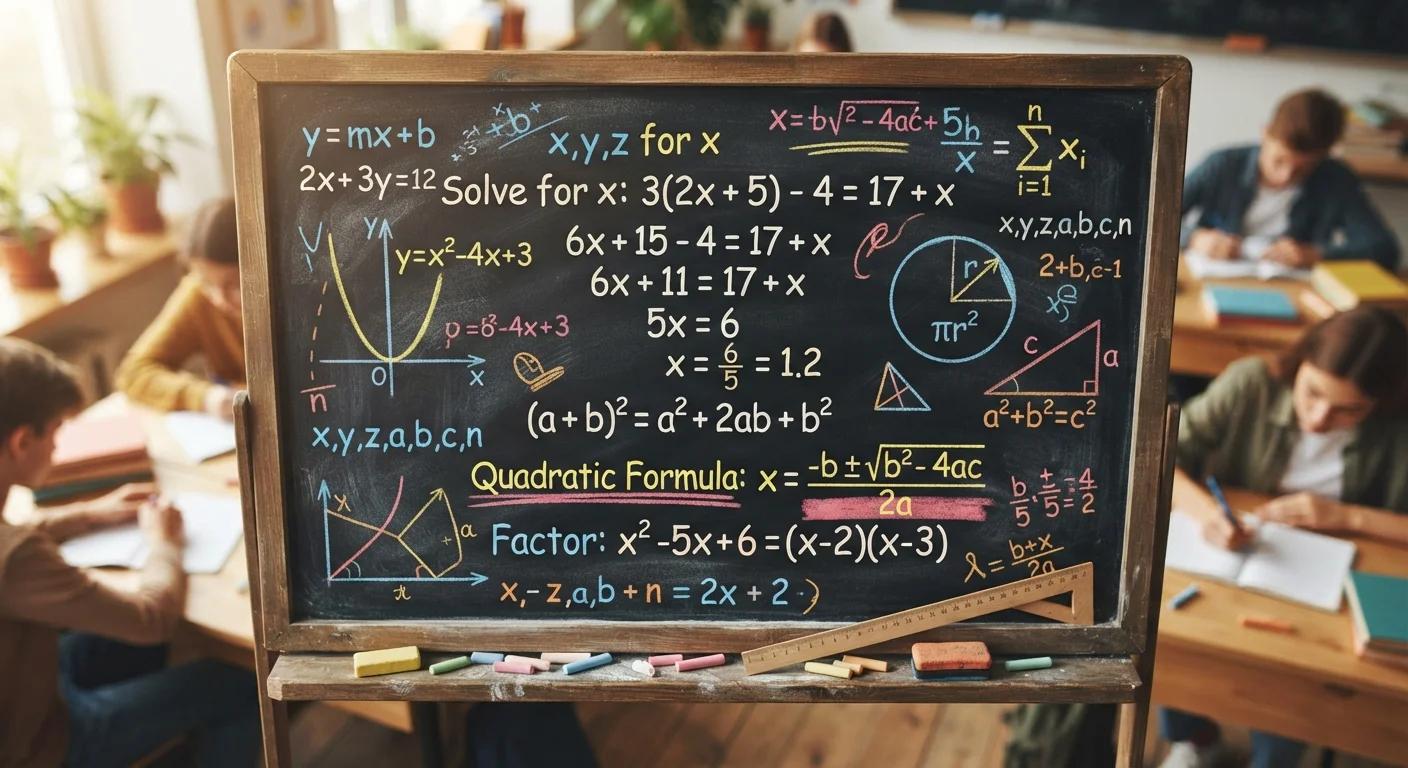
What Algebra Actually Is
Think of arithmetic as the math of known numbers: 3 + 5 = 8. Algebra is the math of unknown numbers - it asks, "what number, when added to 3, gives 8?" The answer is still 5, but now you figured it out through reasoning rather than simple recall.
Algebra is built on a few key ideas:
- Variables: Letters like x, y, or n that stand in for a number you don't know yet.
- Constants: Regular numbers whose value does not change.
- Expressions: Combinations of variables and constants, like 2x + 4.
- Equations: Statements that two expressions are equal, like 2x + 4 = 10.
The goal of most algebra problems is to solve the equation - to find the value of the variable that makes the statement true.
~820 CE
Origin of formal algebra
Al-Khwarizmi's foundational algebraic text, 'Al-Kitab al-mukhtasar fi hisab al-jabr wal-muqabala,' was written around 820 CE and introduced systematic equation-solving.
Grade 8
Common U.S. algebra introduction point
According to the National Council of Teachers of Mathematics, Algebra I is most commonly taught in 8th or 9th grade across U.S. school systems.
Why Letters? The Logic Behind Variables
The use of letters can feel strange at first, but there is a practical reason behind it. Imagine you want to describe the rule for calculating the area of any rectangle. You could list hundreds of examples: a 3×4 rectangle has area 12, a 5×7 rectangle has area 35, and so on. Or you could write one general rule: Area = length × width, often written as A = l × w.
That single formula, using letters, replaces an endless list of specific cases. Letters allow mathematicians and students to express patterns and relationships that hold true no matter what numbers you plug in. This is the power of algebra: it generalizes.
“Algebra is the language through which we describe patterns. Once you see that a letter is just a placeholder for a number you haven't found yet, the mystery disappears.”
— Jo Boaler, Professor of Mathematics Education, Stanford University
The word "algebra" itself comes from the Arabic al-jabr, meaning "reunion of broken parts," found in the title of a 9th-century mathematical text by scholar Al-Khwarizmi. His work systematized the solving of equations - a breakthrough that shaped mathematics for centuries.
Algebra in Everyday Life
You don't need to be sitting in math class for algebra to show up. Consider these situations:
In each case, your brain is naturally doing algebra - setting up a relationship between what you know and what you want to find out. Writing it as an equation just makes that thinking visible and systematic.
Try Naming the Unknown Out Loud
When you encounter an algebra problem, resist the urge to stare at the symbols. Instead, say the equation as a sentence: 'Some number times 4 equals 20.' This verbal translation makes the logic clearer and reduces the intimidation factor considerably. Most students find that understanding improves quickly when they treat algebra as a language, not a code.
Building Confidence With Algebra
One of the biggest obstacles students face is seeing a letter in a math problem and feeling lost. The shift from arithmetic to algebra is a shift in thinking style - from computing answers to reasoning about relationships. That shift takes practice, but it is entirely learnable.
A few strategies that help:
- Read equations in plain language. Instead of seeing x + 5 = 12 as a symbol puzzle, say aloud: "Some number plus 5 equals 12." What number could that be?
- Work backwards. Equations can often be unwound step by step using inverse operations (subtraction undoes addition, division undoes multiplication).
- Connect to real situations. Whenever possible, attach a word problem or real context to an abstract equation. Meaning makes mathematics stick.
Algebra is not about memorizing tricks - it is about learning a language for describing how quantities relate. Once that clicks, math at every level becomes more approachable.
Algebra Is a Stepping Stone, Not a Destination
Mastering algebra opens the door to geometry, trigonometry, statistics, calculus, and beyond. Many students feel pressure to get every problem right immediately - but algebra, like any language, is learned through repeated use and gradual familiarity. Mistakes are a normal and useful part of that process.