
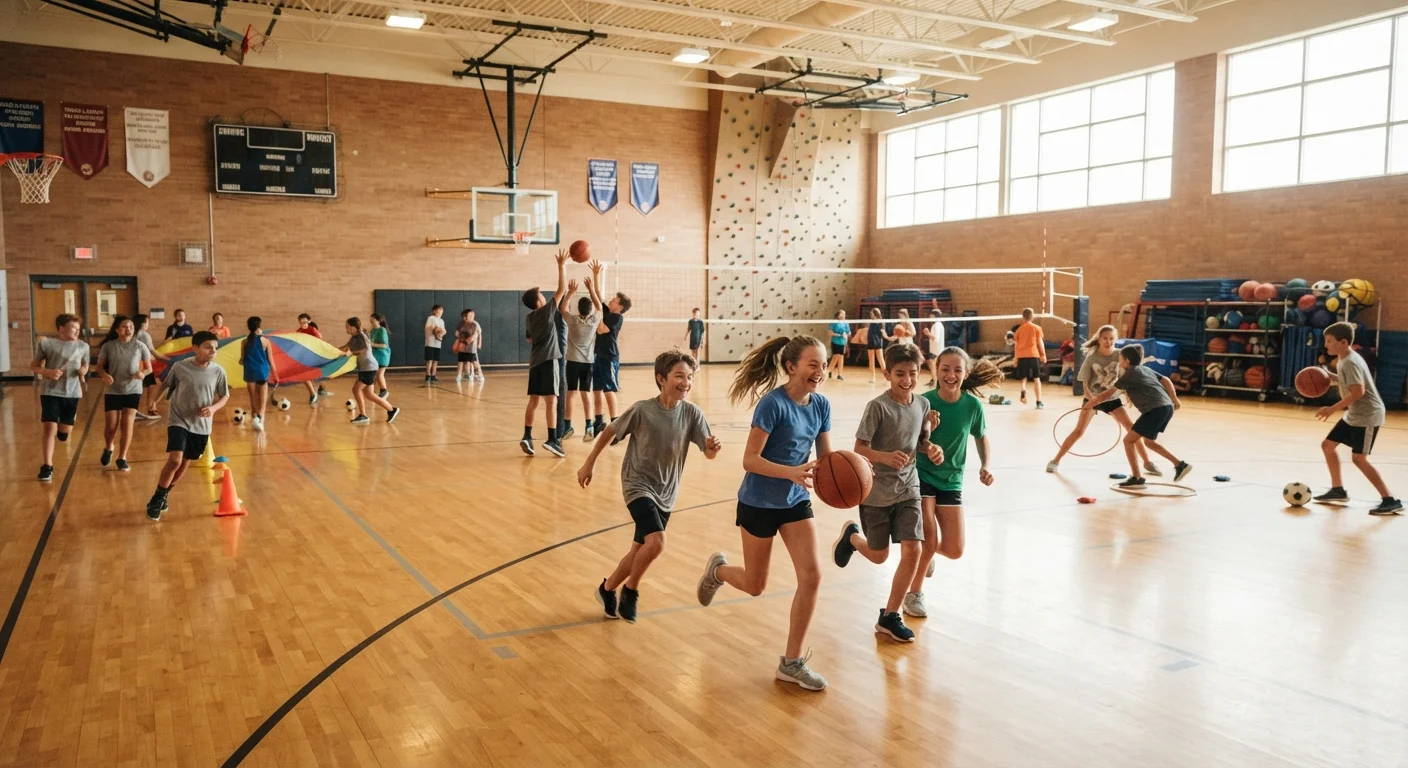
Why PE Gets Underestimated
Physical education occupies a curious place in school culture. Students often welcome it as a change of pace, while administrators under pressure to raise standardized test scores sometimes view it as expendable. Neither framing captures what research actually shows about the role of movement in learning.
The misconception that PE is academically separate - a recess for older students - persists despite decades of evidence pointing the other way. Just as art education has faced similar scrutiny, PE is frequently evaluated by the wrong standard: whether it directly teaches testable content, rather than whether it builds the cognitive and emotional capacity that makes learning possible.
Myth
Physical education is just playtime - it has no connection to academic learning.
Fact
PE develops cognitive skills including attention, memory consolidation, and executive function that directly support academic performance.
Research published in journals such as Pediatric Exercise Science and Educational Psychology Review consistently shows that aerobic exercise increases cerebral blood flow and promotes neuroplasticity - the brain's ability to form and reorganize connections. Students who engage in regular physical activity tend to show improved focus and faster information processing. These are not coincidental benefits; they reflect the underlying biology of how movement primes the brain for learning.
Myth
Replacing PE with extra math or reading time will raise test scores.
Fact
Studies have not found that reducing physical activity in favor of seat time improves academic outcomes - and some show the opposite.
A frequently cited concern in school scheduling is that PE 'takes time away' from core subjects. However, a review by the Centers for Disease Control and Prevention found that increased physical activity time - even at the cost of some instructional time - did not negatively affect academic performance. In several cases, it was associated with modest gains. Cognitive fatigue is real, and movement breaks appear to help students reset their attention capacity for subsequent academic tasks.
Myth
Only athletic or naturally active students benefit from PE class.
Fact
The cognitive and social benefits of structured physical activity extend to all students, regardless of athletic ability.
PE structured around participation, effort, and skill-building - rather than competition - benefits the full range of learners. Research on children with attention-related challenges, for example, has found that regular aerobic activity can reduce inattentive behaviors and improve working memory. For students who struggle in traditional academic settings, PE can also provide a critical confidence-building experience that supports their engagement across the school day.
Myth
The skills learned in PE - like sportsmanship and teamwork - are soft and non-academic.
Fact
Executive function and social-emotional skills developed in PE are foundational to academic success in every subject.
Self-regulation, goal-setting, cooperative problem-solving, and managing frustration under pressure are all practiced in physical education contexts. These are also precisely the skills that predict academic achievement across disciplines. The same capacity that helps a student adapt a game strategy when a plan fails is the capacity they draw on when revising an essay or working through a difficult math problem. Labeling these competencies as 'soft' understates their measurable academic relevance.
Myth
Sedentary students can get the same cognitive benefits through mental exercises alone.
Fact
Physical movement produces neurobiological effects - like elevated BDNF levels - that purely cognitive exercises do not replicate.
Brain-Derived Neurotrophic Factor (BDNF) is a protein that supports neuron growth and learning. Aerobic exercise has been shown to elevate BDNF levels significantly, an effect that cognitive tasks alone do not produce to the same degree. This is not an argument against mental practice - both matter - but it does establish that physical activity contributes something neurologically distinct to the learning process, reinforcing why PE holds a legitimate academic function.
What the Evidence Actually Shows
The relationship between physical activity and brain function is not speculative - it is grounded in neuroscience and supported by large-scale educational research. Regular moderate aerobic exercise has been associated with increases in hippocampal volume, the brain region most closely tied to memory formation. For school-age children still in critical windows of cognitive development, that connection carries significant implications.
PE Is Not a Break From Learning
Federal education research and multiple peer-reviewed studies classify physical education as a core component of student development, not a supplementary or recreational subject. Treating it as disposable can have measurable consequences for student cognition, mental health, and long-term academic engagement.
These findings reinforce the importance of thinking strategically about how students learn, not just what they are taught. The same logic applies to study habits: evidence-based study strategies show us that how information is processed matters as much as how much time is spent. PE, in this sense, is part of the same broader conversation about learning effectiveness.
1.5×
Attention improvement after aerobic activity
Research compiled by the CDC's Division of Population Health found that physical activity was associated with improved concentration and on-task behavior in classroom settings.
52%
Studies showing academic benefit from PA
A CDC review found that over half of all studies examining the relationship between school-based physical activity and academic performance reported a positive association.
60 min
Daily physical activity recommended for school-age children
The U.S. Department of Health and Human Services Physical Activity Guidelines recommend at least 60 minutes of moderate-to-vigorous activity per day for children aged 6-17.
None of this means every PE class automatically produces academic benefits - program quality, student engagement, and instructional design all matter. But the evidence is clear that dismissing physical education as non-academic misreads both the science and the purpose of a well-rounded education.