
Does Age Really Matter? What Research Shows
The popular belief is simple: start young and fluency follows. The reality, according to decades of applied linguistics research, is more nuanced. Young children do have advantages in phonological acquisition - picking up native-like pronunciation is generally easier before puberty, a phenomenon linked to what researchers call the critical period hypothesis. However, older learners - teenagers and adults - often learn grammar rules and vocabulary more efficiently in the short term because of stronger cognitive skills.
A large-scale study of school programs in Europe found that students who began foreign language instruction in later primary grades sometimes caught up with or surpassed earlier starters within a few years, particularly when instruction quality was high. The takeaway: early exposure helps with accent and listening, but it is not the only variable that matters. Curriculum design, classroom hours, and teaching approach all play equally significant roles.
“The notion that there is a single, fixed window for language learning misrepresents the research. What matters most is the quality and quantity of input, and the opportunity to use the language meaningfully.”
— Patricia Kuhl, Co-director, Institute for Learning & Brain Sciences, University of Washington
Which Teaching Methods Actually Work
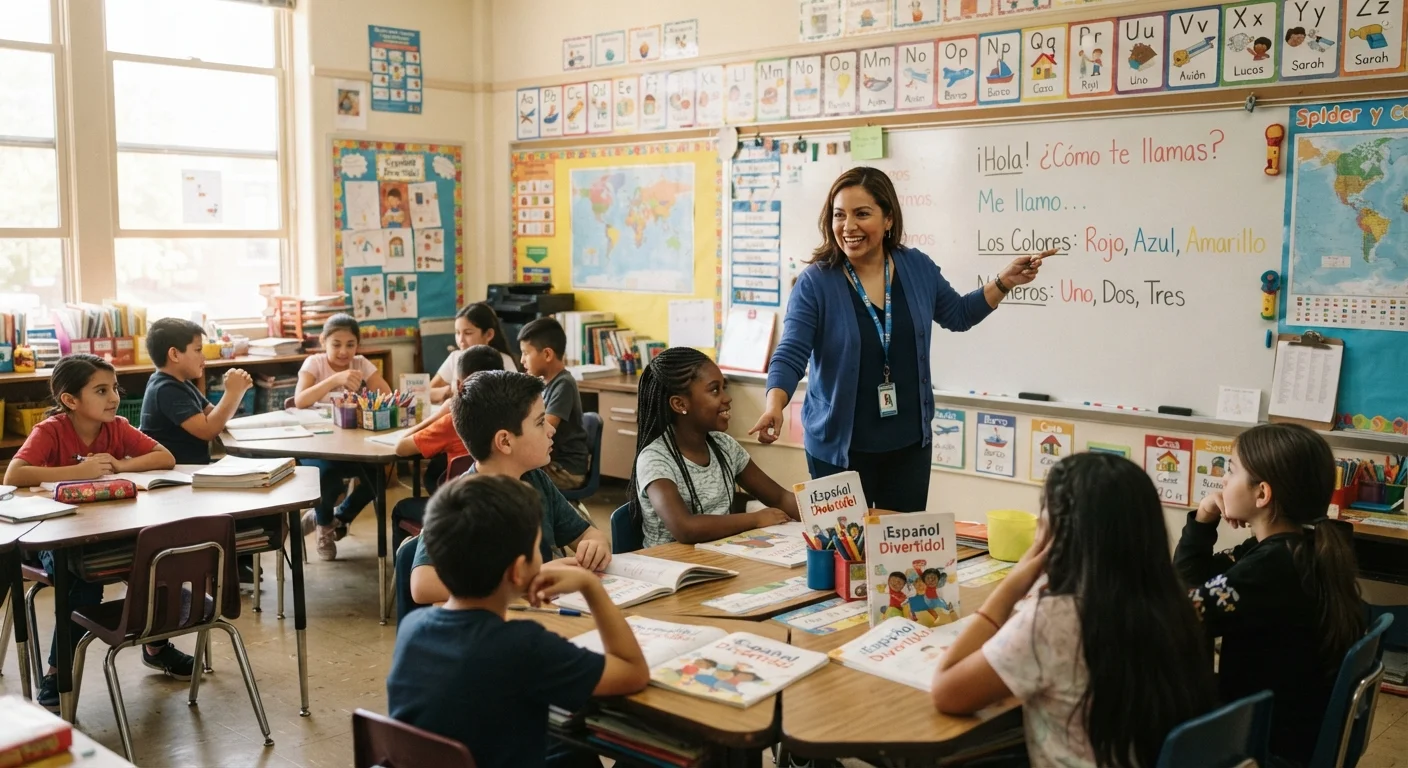
Decades of classroom research point consistently toward communicative language teaching (CLT) - an approach that prioritizes using the language for real purposes rather than memorizing rules in isolation. Students make faster and more durable progress when they negotiate meaning, respond to authentic tasks, and interact with peers in the target language.
That does not mean grammar instruction has no place. Explicit teaching of grammar structures, especially when tied to communication, helps learners notice patterns they might otherwise overlook. The most effective classrooms tend to blend both: structured input followed by opportunities to produce the language meaningfully.
As you evaluate what your child's school offers, evidence-ranked study techniques can also inform how students practise vocabulary and grammar outside the classroom. Similarly, it is worth noting that matching instruction to supposed "learning styles" has little research support - for more on that, see why learning styles are considered a myth.
Prioritize communicative practice over grammar drills alone.
Learners who use a language to communicate real ideas build stronger, more flexible skills than those who only study rules. Grammar instruction is most effective when it supports meaningful use rather than replacing it.
Increase contact time with the target language wherever possible.
Frequency and volume of meaningful exposure are among the strongest predictors of acquisition. Even modest increases in weekly practice time compound significantly over a school year.
Deliver corrective feedback consistently but supportively.
Research shows that learners who receive clear, non-shaming correction develop more accurate language over time. The key is feedback that redirects without discouraging further attempts.
Create low-anxiety environments that treat mistakes as learning data.
High anxiety - sometimes called a raised affective filter - measurably reduces the amount of language input a learner can process. Reducing fear of judgment increases both participation and retention.
Connect language learning to authentic cultural content.
Motivation is a key driver of language persistence. Students who engage with real songs, stories, or films in the target language develop intrinsic reasons to keep learning beyond the grade.
The Role of Exposure, Frequency, and Program Type
Time on task is one of the most robust predictors of language progress. A student receiving 30 minutes of Spanish instruction twice a week will, on average, progress more slowly than one enrolled in a structured dual-language or immersion program where the language serves as a medium for learning other subjects. The difference is total comprehensible input - the amount of meaningful language the learner processes over time.
~1,000
Hours to reach basic proficiency in a related language
The U.S. Foreign Service Institute estimates approximately 600-750 classroom hours for easier languages and up to 2,200 for harder ones - highlighting how far most school programs fall short of fluency thresholds.
2x
Proficiency advantage for immersion vs. traditional programs
Reviews of dual-language immersion research, including work by researchers at George Mason University, suggest immersion students often outperform peers on language assessments by a factor of roughly two after several years.
Immersion and bilingual programs typically require significant institutional commitment, but even within conventional programs, small increases in weekly contact time produce measurable gains. When full immersion is not available, encouraging students to engage with the language outside the classroom - through music, podcasts, or conversation partners - can meaningfully supplement school instruction. Research on community and collaborative learning suggests that pairing students for peer practice has real benefits; solo versus community-based learning explores that trade-off in depth.
Supporting Young Language Learners at Home and at School
Parents and educators don't need to be bilingual themselves to support second-language development. Consistent encouragement, access to media in the target language, and low-anxiety environments where mistakes are treated as a normal part of learning all contribute meaningfully to progress. Research on affective filters - a concept from language acquisition theory - suggests that anxiety and fear of embarrassment actively slow acquisition. Classrooms and homes where effort is praised over perfection tend to produce more confident, capable speakers.
What 'Comprehensible Input' Means
Comprehensible input - a term coined by linguist Stephen Krashen - refers to language that learners can mostly understand, with just enough challenge to push their skills forward. It is widely cited in second-language acquisition research as a central mechanism of natural language development. In practice, it means instruction should be slightly above a student's current level - challenging but not incomprehensible.
Schools can also look beyond language class itself. Some research suggests that students who study arts and humanities develop stronger cross-cultural empathy - a disposition that motivates language learning. For a broader look at what enrichment subjects contribute, research on art class and academic achievement offers useful context.
Ultimately, the evidence points toward a consistent message: the best second-language outcomes come from frequent, meaningful engagement with the language, delivered through well-designed instruction, supported at home, and sustained over years - not months.