
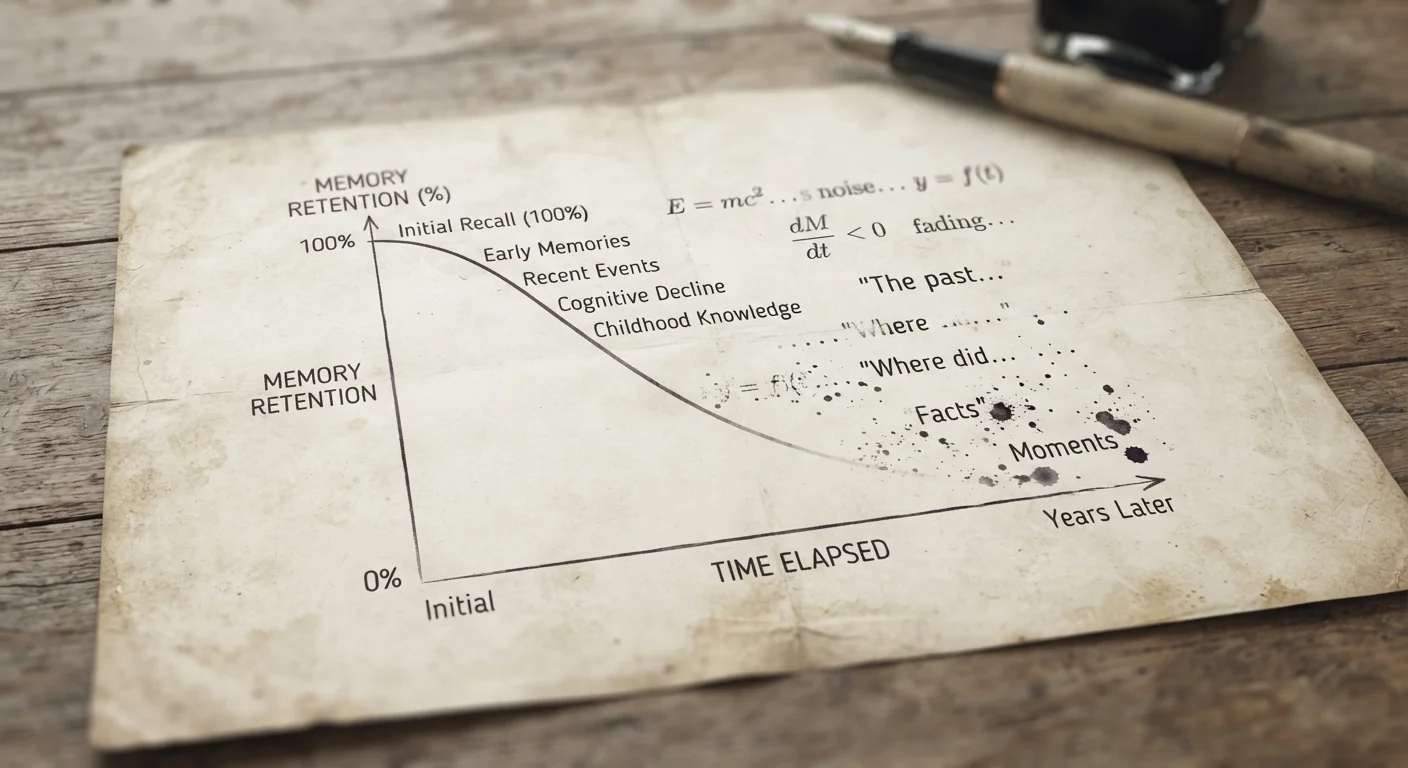
Where the Forgetting Curve Comes From
In the 1880s, Hermann Ebbinghaus conducted a series of meticulous self-experiments, memorizing lists of nonsense syllables - strings like "DAX" or "BUP" - and then testing himself at intervals to see how much he retained. What he charted was striking: memory loss is not gradual and linear. It is rapid and exponential at first, then it slows.
His findings showed that within the first hour after learning, a large portion of new information is already gone. By the end of the first day, retention can drop to under a third of the original material. Yet information that survives several days tends to persist much longer - the curve flattens as stable long-term memories form.
Ebbinghaus also discovered something hopeful: relearning forgotten material takes noticeably less time than the original learning. He called the difference the savings. Even when conscious recall fails, a trace of the learning remains - and that trace makes rebuilding memory faster.
“The connection which has been formed between two ideas is not simply either present or absent; it exists rather in all possible degrees of strength.”
— Hermann Ebbinghaus, German psychologist and pioneering memory researcher
Why Memories Fade So Quickly
Memory is not a recording. When you encounter new information, your brain encodes it as a fragile pattern of neural connections. Without reinforcement, those connections weaken through a process researchers often describe as trace decay - the physical substrate of the memory literally degrades if it goes unused.
There is also the problem of interference. New information competes with old, and similar material can overwrite or blur earlier memories. This is why studying similar subjects back-to-back can make both harder to retain.
A third factor is lack of meaningful connection. Ebbinghaus used nonsense syllables deliberately - material with no hooks to existing knowledge. In everyday learning, information tied to what you already know, or to strong emotions and experiences, is forgotten far more slowly because it integrates into existing memory networks rather than floating in isolation.
~56%
Information forgotten within one hour
Ebbinghaus's own experiments suggested retention dropped to roughly 44% within 60 minutes of learning nonsense syllables without review.
~66%
Information forgotten within one day
After 24 hours without review, Ebbinghaus found retention falling to around 34%, illustrating the steep early drop of the forgetting curve.
5-10×
Faster relearning with spaced review
Research building on Ebbinghaus's savings method shows repeated spaced review can dramatically reduce the time needed to relearn material.
How Reviewing Resets the Curve
The most important practical insight from Ebbinghaus's work is that each review session does not simply remind you of something - it rebuilds and strengthens the underlying memory trace. After a review, the forgetting curve starts again, but from a higher baseline and with a shallower slope. You forget less quickly the next time.
This is why cramming - studying everything the night before - produces such poor long-term results. Even if you score well on an exam days later, the material evaporates rapidly because the memory trace was never reinforced across time. The information had only one steep curve, never flattened by spaced exposure.
Spreading reviews across increasing intervals - sometimes called spaced repetition - is the evidence-based antidote. Reviewing after one day, then after three days, then after a week, then after two weeks, progressively consolidates the memory until it becomes durable. Our field guide to study methods breaks down how to put this into practice alongside other research-backed techniques.
The 24-Hour Review Rule
One of the highest-impact habits you can build is reviewing new material within 24 hours of first encountering it. This brief window is when the forgetting curve drops most steeply. Even a ten-minute review - recalling key points without looking at notes first - can substantially raise the baseline from which your next forgetting curve begins.
Practical Ways to Work With Your Memory
Understanding the forgetting curve changes how you approach learning. Rather than asking "how long did I study?" you begin asking "when will I review this again?"
- Review within 24 hours. A brief review the day after first learning something - even ten minutes - dramatically slows the initial steep drop of the curve.
- Test yourself, don't just reread. Retrieving information actively is far more effective than passive re-exposure. Active recall consistently outperforms passive review in retention studies.
- Connect new ideas to existing knowledge. The more meaningful the material, the slower it fades. Relate new concepts to things you already understand or care about.
- Build structure into sessions. A well-organized study session accounts for both initial learning and planned future review. See how to build a study session that actually sticks for a practical framework.
The forgetting curve is not a verdict on your intelligence - it is a description of how human memory works under normal conditions. Knowing the curve exists, and that deliberate review reshapes it, puts you in control of what you keep. Explore more study skills and retention strategies to continue building your learning toolkit.