
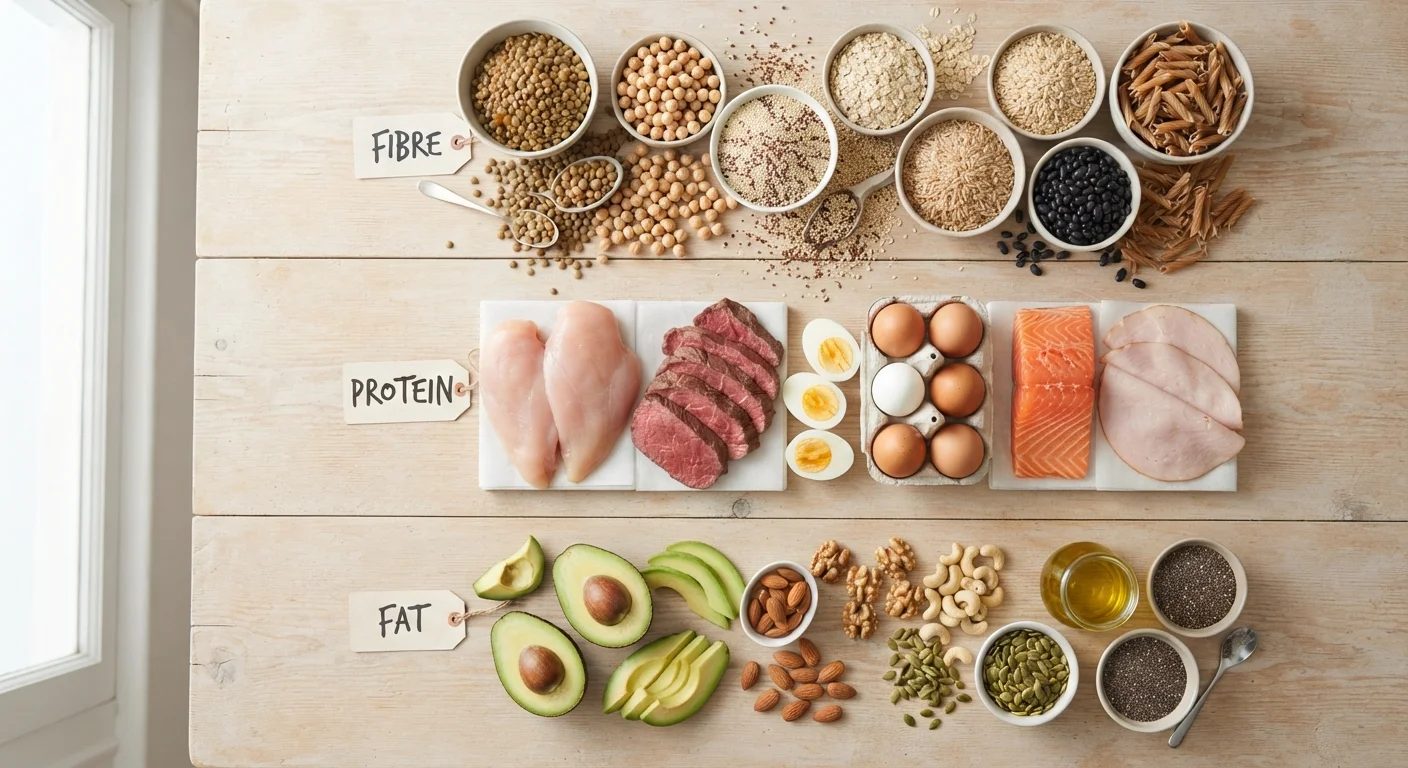
Why Macronutrients Matter
Most nutrition conversations jump straight to calories, but calories alone don't tell you much about what food actually does inside the body. That's where macronutrients come in. The term refers to the three main categories of nutrients the body needs in relatively large amounts: fibre, protein, and fat. Each serves a distinct set of functions, and understanding those functions helps make sense of everyday eating choices.
| Calories per gram - fat | 9 kcal/g (Standard nutritional convention) |
| Calories per gram - protein | 4 kcal/g (Standard nutritional convention) |
| Calories per gram - carbohydrate | 4 kcal/g (Standard nutritional convention) |
| Recommended daily fibre intake (adults, US) | 25-38 g/day (Dietary Guidelines for Americans) |
| Essential amino acids | 9 (World Health Organization) |
| Fat-soluble vitamins | A, D, E, K (Require dietary fat for absorption) |
It's worth noting that carbohydrates are technically the broader category, with fibre being a specific type. This article focuses on fibre separately because its role differs substantially from other carbohydrates - particularly in that the body cannot fully digest it. For a deeper look at how these nutrients fit together in practice, see what a balanced diet actually means.
Fibre: The Structural Carbohydrate
Fibre is a type of carbohydrate found primarily in plant foods - vegetables, fruits, legumes, and whole grains. Unlike sugars and starches, dietary fibre passes largely undigested through the small intestine and reaches the large intestine, where it plays a range of important roles.
Soluble fibre dissolves in water to form a gel-like substance. This slows the absorption of glucose, which helps moderate blood sugar responses after meals, and can support healthy cholesterol levels. Oats, beans, apples, and flaxseed are common sources.
Insoluble fibre does not dissolve in water. It adds bulk to stool and supports regular bowel movement by speeding transit through the intestines. Whole wheat products, nuts, and many vegetables are rich sources.
Beyond digestion, fibre acts as a prebiotic - feeding the beneficial bacteria that live in the gut. A well-fed gut microbiome is associated with a range of health markers, from immune function to mood regulation, though research in this area is still evolving.
Macronutrient
A nutrient the body requires in relatively large quantities to function. The three main macronutrients are carbohydrates (including fibre), protein, and fat, each providing energy and serving distinct physiological roles.
Dietary fibre
A type of carbohydrate found in plant foods that resists digestion in the small intestine. It supports bowel regularity, feeds gut bacteria, and can help moderate blood sugar and cholesterol levels.
Essential amino acids
The nine amino acids the body cannot synthesise on its own and must obtain from food. They are required for building and repairing proteins throughout the body.
Thermic effect of food
The energy the body expends digesting, absorbing, and metabolising nutrients. Protein has the highest thermic effect of the three macronutrients, meaning more calories are used to process it.
Unsaturated fat
A category of dietary fat found in plant oils, nuts, seeds, and oily fish. Mono- and polyunsaturated fats are generally associated with heart health when consumed as part of a balanced diet.
Prebiotic
A substance - often a type of fibre - that feeds and supports the growth of beneficial bacteria in the gut. Prebiotics help maintain a healthy gut microbiome.
Protein: The Body's Building Material
Protein is made up of amino acids - small molecules that the body chains together to construct and maintain virtually every structure it has. Muscle, bone, skin, enzymes, hormones, and immune antibodies all depend on a steady supply of protein.
The body can produce some amino acids on its own, but nine - called essential amino acids - must come from food. Animal-based proteins (meat, fish, dairy, eggs) generally contain all nine in adequate amounts and are called complete proteins. Most plant proteins are incomplete, meaning they are lower in one or more essential amino acids. However, eating a varied plant-based diet across the day provides all essential amino acids without needing to pair specific foods at every meal.
Protein also plays a role in satiety. It tends to be the most filling macronutrient per calorie, in part because digesting it requires more energy than digesting fat or carbohydrate - a phenomenon known as the thermic effect of food.
Timing and distribution of protein intake is an active area of research. For context on how meal timing intersects with nutrient use, see the science on eating windows and meal timing.
Fat: Essential, Not the Enemy
Dietary fat has spent decades unfairly cast as the villain of nutrition. In reality, fat is essential. It provides a concentrated source of energy, helps the body absorb fat-soluble vitamins (A, D, E, and K), supports cell membrane integrity, and is the raw material for several hormones.
The type of fat matters more than the total amount. Unsaturated fats - found in olive oil, avocados, nuts, and oily fish - are associated with cardiovascular health in a substantial body of research. Saturated fats, abundant in fatty red meat and some dairy, are best consumed in moderation according to most dietary guidelines. Trans fats, largely produced through industrial hydrogenation of vegetable oils, are associated with adverse cardiovascular effects and have been significantly reduced or removed from the food supply in many countries.
Fat also slows gastric emptying, meaning meals that include fat tend to keep you fuller for longer and help moderate the speed at which other nutrients enter the bloodstream.
95%
Americans not meeting daily fibre recommendations
According to data cited by the American Society for Nutrition, the vast majority of US adults consume well below the recommended daily fibre intake.
9 kcal/g
Energy density of dietary fat
Fat provides more than twice the calories per gram compared to protein or carbohydrate, making it the body's most energy-dense macronutrient.
20-30%
Thermic effect of protein
Research estimates the body uses roughly 20-30% of protein's calories just to digest and process it, compared to around 5-10% for carbohydrates.
How They Work Together
No macronutrient works in isolation. A meal that combines fibre-rich carbohydrates, a source of protein, and some healthy fat will generally produce a more gradual and sustained energy response than one built on a single macronutrient. Fibre slows digestion, fat moderates glucose absorption, and protein contributes to satiety and tissue repair simultaneously.
Balance, rather than elimination or excess of any one macronutrient, is what most nutrition science points toward. Extreme restriction of fat, protein, or carbohydrates can disrupt the body's ability to perform functions that depend on those nutrients. For a fuller picture of what dietary balance looks like in practice, see our explanation of what a balanced diet actually means.
This article is for general informational purposes only and does not constitute medical or dietary advice. Speak with a qualified healthcare professional or registered dietitian for guidance tailored to your individual health needs.