
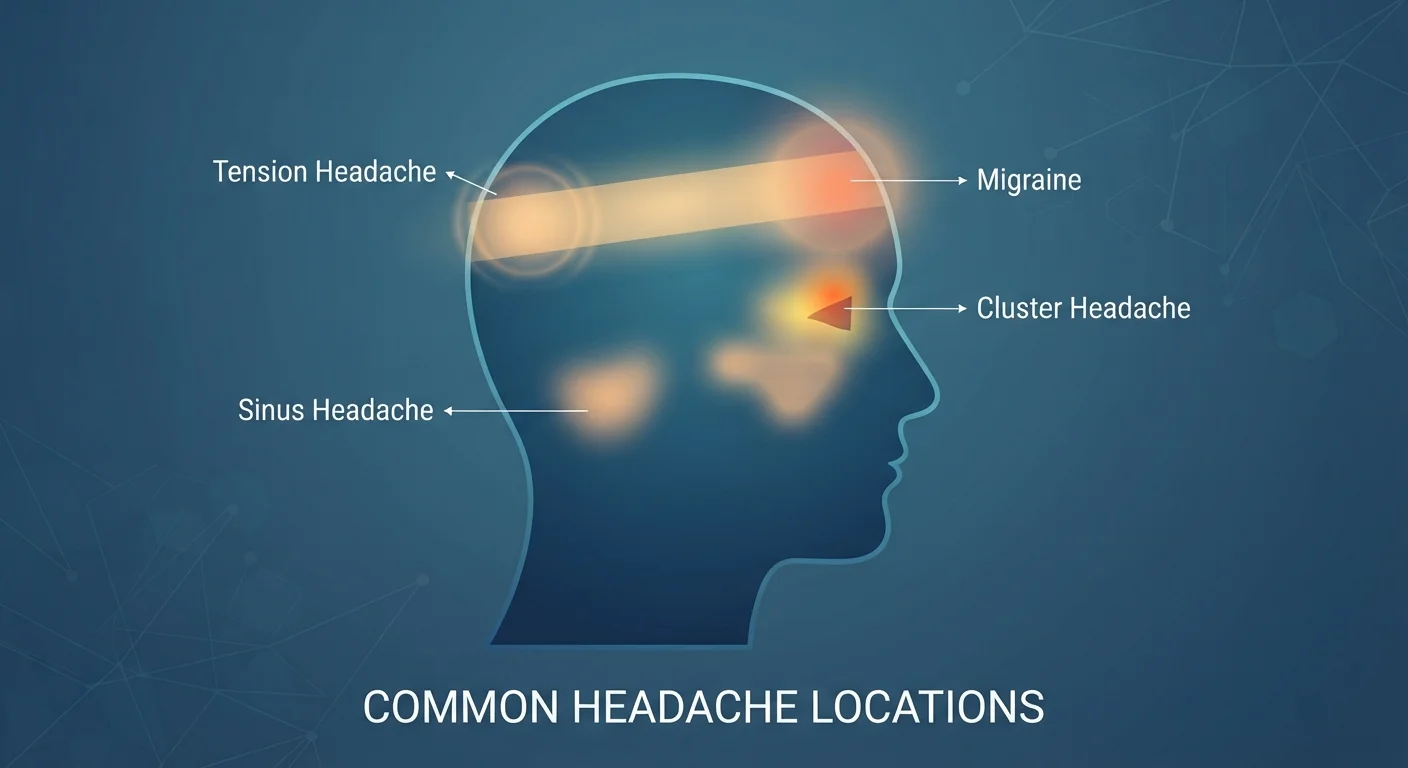
Why Location Matters
Not all headaches are the same, and where the pain is felt is one of the most telling details a healthcare provider will ask about. The skull, scalp, sinuses, neck muscles, and blood vessels each contribute to pain in distinct patterns. While location alone cannot diagnose a cause - and should never replace a professional evaluation - it can help narrow the possibilities and guide a productive conversation with a doctor.
| Most common headache type | Tension-type headache (World Health Organization) |
| Typical tension headache sensation | Dull, pressing band around the head |
| Classic migraine feature | One-sided throbbing pain, often with nausea (International Headache Society) |
| Cluster headache pain location | Around or behind one eye |
| Sinus headache hallmark | Facial pressure worsened by bending forward |
| Emergency warning sign | Sudden thunderclap headache at peak intensity (American Headache Society) |
This article is for general informational purposes only and is not a substitute for medical advice. If you experience sudden, severe, or unusual headache symptoms, consult a qualified healthcare professional promptly.
Common Headache Locations and Their Likely Signals
Forehead and Both Temples
Pain spread across the forehead or wrapped around both sides of the head - often described as a tight band - is a hallmark of a tension-type headache, the most common headache type in adults. Stress, poor posture, eye strain, and dehydration are frequent contributing factors.
Behind One or Both Eyes
A deep, pressure-like ache behind or around the eyes is frequently associated with sinus headaches when accompanied by nasal congestion, or with migraines when paired with sensitivity to light or sound. Cluster headaches - less common but intense - typically produce stabbing pain around one eye, often with tearing or nasal discharge on the same side.
One Side of the Head
Unilateral (one-sided) throbbing pain is a classic feature of migraine. It may shift sides between episodes. Migraines often involve additional symptoms such as nausea, visual disturbances (called auras), or heightened sensitivity to sensory input.
Back of the Head and Neck
Pain at the base of the skull radiating up or into the neck and shoulders often points to tension headaches triggered by muscle tightness, or to occipital neuralgia - irritation of the nerves running from the upper spine through the scalp. Poor workstation ergonomics and prolonged screen time are common contributors.
Tension-type headache
The most prevalent headache type, typically felt as a dull, pressing band around the head. It is commonly linked to muscle tension, stress, or fatigue rather than neurological dysfunction.
Migraine
A neurological condition characterized by recurring, often one-sided throbbing headaches that may include nausea, light sensitivity, and visual disturbances called auras.
Occipital neuralgia
Irritation or injury of the occipital nerves, which run from the upper spine to the scalp, causing sharp or aching pain at the back of the head.
Sinusitis
Inflammation of the sinus cavities, often following a respiratory infection, which can produce facial pressure and headache around the cheeks, eyes, and forehead.
Cluster headache
A less common but very intense headache type occurring in cyclical patterns, with severe pain typically concentrated around one eye, often accompanied by eye tearing or nasal discharge.
Aura
Temporary neurological symptoms - most often visual disturbances such as flickering lights or blind spots - that can precede or accompany a migraine episode.
Top of the Head
Headaches felt at the crown are less common and can be associated with tension patterns or, in some cases, with positional changes in blood pressure. Any headache that suddenly peaks in intensity warrants immediate medical attention.
Facial Pain and Cheekbones
Pain concentrated in the cheeks, upper teeth, or around the nose - especially with a recent cold - is often linked to sinusitis, where inflamed sinus cavities create pressure. Bending forward typically worsens this type of discomfort.
When to Seek Medical Attention
Most everyday headaches resolve with rest, hydration, or over-the-counter measures. However, certain features should prompt a call to a healthcare provider without delay:
- A headache that comes on suddenly and reaches peak intensity within seconds (sometimes called a thunderclap headache)
- Headache accompanied by fever, stiff neck, confusion, vision changes, or weakness
- A new or different headache pattern in someone over 50
- Headache following a head injury
- Progressively worsening headaches over days or weeks
A Headache Diary Can Help Your Doctor
Recording where your headache occurs, how long it lasts, what you were doing beforehand, and any associated symptoms gives a clinician valuable pattern information. Even a few weeks of notes can help distinguish between headache types and identify potential triggers. Many smartphone health apps include a headache tracking feature, or a simple paper log works equally well.
Keeping a simple headache diary - noting location, duration, intensity, and any triggers - can meaningfully improve the information you can share with a clinician, leading to more accurate guidance.